 If other major components are changed, one must rely on
trial and error. However, in every case it is the FSE and the AFM that
will solve the problems.
If other major components are changed, one must rely on
trial and error. However, in every case it is the FSE and the AFM that
will solve the problems.
Can anyone please tell what a rising rate fuel regulator
achieves on a fuel injected engine?
Roger
Depends which fuel injected system you have. Here is what they do and can be used for on pre-GEMS Rover systems.
REGULATES FUEL PRESSURE
Precise Fuel pressure is key for all EFIs. Outside of the newest systems which adjust timing and even the cooling fan with their 'puters, most EFI have only one tool to do their bidding...that is the the control of the duration the injectors are open. The ECU responds to each set of inputs by opening the injectors for a pre-determined period (according to the fuel map). If duration is the only control, fuel pressure must be a given. The regulator is be used to maintain the precise pressure require and then returns any fuel unnecessary to that task back to the fuel tank.
(More than any other single thing about them, the advantage of any FI system is the fine super combustible air/fuel mixture it creates. The programming can be great..but in these later days, it is used to obey emission laws and reduce warranty claims rather than produce power.)
RISING RATE
At times, in demand situations such as high acceleration, the engine needs more fuel. Rather than program a second set of fueling parameters to deal a special situation, one can take another route to the same place by using mechanics rather than ECU programming. Rising rate regulators are used. By having it react to engine vacuum (hose to the plenum), it temporarily increases fuel pressure on demand. By doing so, you are injecting more fuel though the injector duration remains the same. Most of these devices increases the pressure at a rate higher than the stock regulators do..thereby giving you greater acceleration.
ADJUSTABLE
The fuel pressure the FSE maintains can be adjusted in a very large range. For a digitally operated EFI system that means that anomalies in the pressure can be tweaked out. Like most devices designed to fit a wide range of engines, they are a one-size-fits-all device. This is great, as stock regulators, over time, wear a bit and move away from the desired constant pressure But aftermarket adjusables can be set to an ideal with the turn of a screw.
Additionally, with a simplistic Flapper system, (aka Bosch L-Jetronics used on Plus 8s and Plus 4s from 1984-1991) with their analogue computers, limited inputs and no controls on emissions, adjusting the fuel pressure adjusts the fueling..aka reprograms the car. Very handy for the race track and engine upgrades. Let's say you were increasing your capacity from a Rover 3.5L to a LR 3.9 or 4.0L (3528cc to 3947cc) or an increase or 11.8%. In doing so. by increasing the capacity you "lean out" your fueling by the increased capacity. Your ECU can still run the engine, but it is no longer optimum..and may have a tendancy to overheat. By increasing the fuel pressure, you can adjust the fuel system to the new needs.
As well, you would not see much advantage (a bit more torque) in the extra capacity as there would be nothing more going into the combustion process. The situation would be analogous to the Morgan stock Plus 8 4.6s, where 3.9 fueling was used with them. The bhp rose negligibly (4 bhp) rather than the extra 28 bhp 4.6s produced in other vehicles with the proper fueling. With a digital system, reprogramming would be called for. However, with a Flapper, one can simply increase the fuel pressure with a FSE. I have successfully used a 3.5 flapper system to smoothly run a 4.6 and 4.8.
Ideally, once can do even better than that..over time as well. Find a way to increase airflow a bit more, a K&N/Superflare trumpets OR a Jaguar AFM. In any case the "programming" is evident assuming the same injectors before and after. Simply increase the fuel pressure 12%, then re-tension, the spring wheel in the AFM until the C02 reading at the exhaust at 850 rpm is 2%ish. Then set your idle at 1000-1050 rpm.
If other major components are changed, one must rely on
trial and error. However, in every case it is the FSE and the AFM that
will solve the problems.
P.S. Opening up a L-Jetronic AFM is considered taboo. There is a supposedly a bit of risk to it..but I have never seen why. One must take care of the way one puts the cover back on. The wrong sealant and the AGM can supposedly fail. (Use sensor safe sealant) https://www.gomog.com/allmorgan/AFMadjust.html
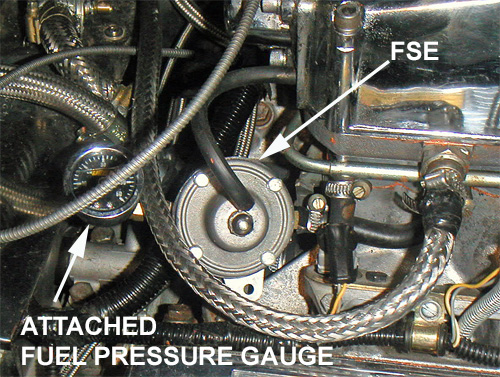
DIAGNOSTICS Fuel Pressure Gauge Permanently Installed
These devices also allow you to add a fantastic diagnostic
feature to your car. Again, being one-size-fits-all means they have
to have redundancy, in this case an unused plugged port on one side.
Engine problems come in only two grouped types, reflecting the two
things you need for combustion, fuel and a spark. If you install a
permanent fuel pressure gauge on the unused port, you can eliminate
one of the two problem areas (fuel or spark) as a culprit at a glance at the gauge
when you turn the ignition key! You can also make sure the fuel
pressure is correct at all times.
How much does this cost? About 8£ if you buy the one I have. I
got mine from JEGS in the USA. They will also ship the UK.
Labor is give or take 3 minutes if the FSE is already installed.
THE VALVE IN THE VACUUM
LINE FROM THE DISTRIBUTOR TO THE PLENUM
by Lorne Goldman
The little black and red plastic valve in the vacuum line
between the distributor and the plenum (if you still have it) isn't actually
a non-return valve. It's a valve that slows 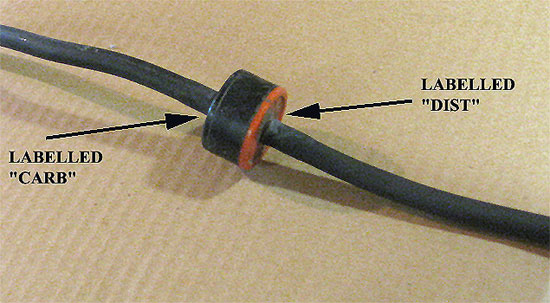 return
and is made to it leak air back (at least when it is working properly).
The vacuum advance line is connected to a throttle edge tapping in the
throttle assembly on the plenum nose.
return
and is made to it leak air back (at least when it is working properly).
The vacuum advance line is connected to a throttle edge tapping in the
throttle assembly on the plenum nose.
With the tapping into the plenum here, most of the time
that means it is connected downstream of the throttle plate and sees manifold
depression, but at idle, when the throttle plate moves past the tapping,
it sees normal atmospheric 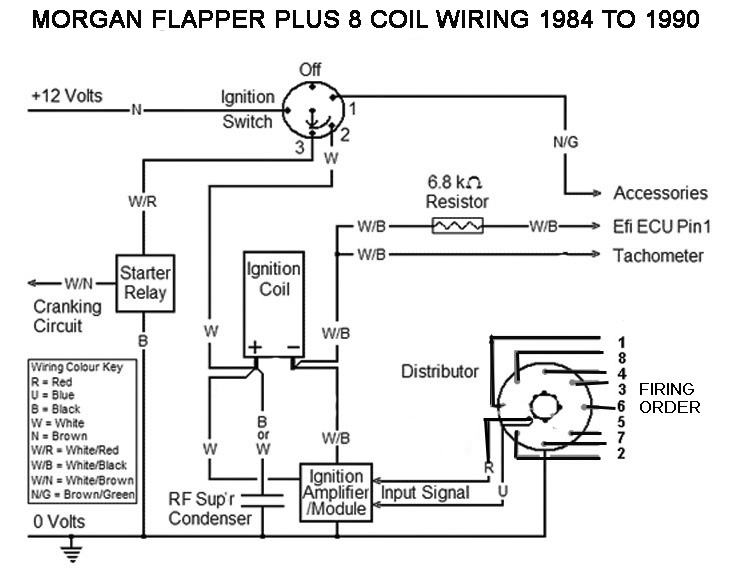 pressure. The aim is to give plenty of vacuum
advance under cruise conditions but none at idle. But there's a design
issue here.
pressure. The aim is to give plenty of vacuum
advance under cruise conditions but none at idle. But there's a design
issue here.
Normally, when you slam the throttle open from idle, that
will create a brief spike of vacuum. It takes the distributor a time to
respond and recover from this and that, in turn, interferes with the throttle
response. The purpose of the valve is to prevent the vacuum advance from
operating unless the depression is sustained for longer than a couple of seconds to prevent this hiccup.
Of course, it is all too easy to fit the valve the wrong way round, some
people have even done this deliberately based on a misunderstanding of
how the valve works. The valves often get clogged up completely
in which case all bets are off. If in doubt. just get rid of the valve
completely, since the problem it aims to cure is trivial compared to some
of the problems it can cause.
TACHOMETER/ECU ENGINE PULSE SIGNAL
by Lorne Goldman
This
is a little gubbin that can stop you in your tracks. The ECU requires a
engine signal pulse to determine rpm and fueling. No signal, no fuel
to the injectors. People can turn their engine over in an effort to
start it until their battery goes dead. They finally call a towing
service, take it to be looked at by youngsters who have no clue and
1000s later (the currency does not matter at this point) they go home after a "fix" that should have taken seconds.
On
a Flapper Plus 8 (1984 to 1990), the signal comes from the coil. It is
a white wire with a black tracer. It travels from the coil to the
tachometer and the ECU (pin 1). Depending where the signal ended, your
tachmeter will not work either. Check your coil connections and the
route at the bulkead (next to the windscrren wipers and where it dives
into the behind-the-dash area.