DATSUN/ALFIN BRAKE DRUMS
by Lorne Goldman, Harald Sakshaug & the gang
at the eMog Pub
May 1998, updated December 2002, updated December 2005, March
2008, January 2009, October
2009, August 2012 December 2025
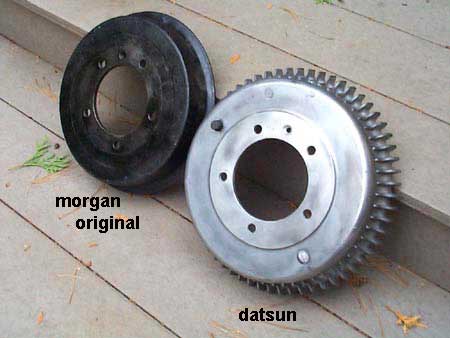
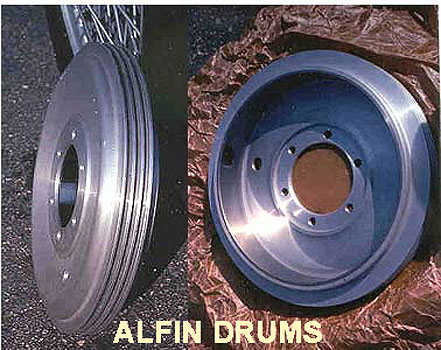 Datsun
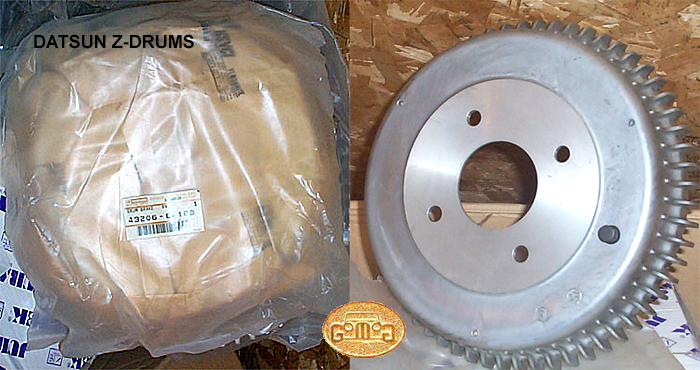
Z drums, (designed along the same idea of the famous Alfin drums but frankly
MUCH better) were made in bimetal of cast aluminum with fins for extra cooling
and a steel insert and used on the famous Datsun Z sports cars series.
Datsun
Z drums, (designed along the same idea of the famous Alfin drums but frankly
MUCH better) were made in bimetal of cast aluminum with fins for extra cooling
and a steel insert and used on the famous Datsun Z sports cars series.
The advantages are much improved rear braking, cooler
drums, a big saving in unsprung weight and of course, the ability to shine them up to a
gleaming finish (smile)..all without modifying the car. When I tested them,
I tested them hard...yet when I stopped that car after some time of this,
the Datsun brake drums were only tepid to the touch. The used Alfins I had tried earlier ran hotter.
The
problem will be to find used Datsun
drums still in good condition with only acceptable wear. The maximum
wear
permissible is marked on each drum on their inner surface. I have seen
a good used set go for $850 USD without machining. I found my set
(s) , all dusty and covered with yellowed paper, at the
Nissan depot in Vancouver, Canada
for $92 CAN. Part number is 43206-E4100. I
bought all 7 sets they had (30 years ago). I kept what I need for
my Morgans, plus an emergency set and gave the others to Morgan friends
as Xmas as birthday presents.
Sadly, re-stocking was even then impossible for Datsun/Nissan.
They
switched to the aftermarket which supplied of lower quality
replacements and soon after, stop carrying them at all. Other attempts
to copy the originals did not turn out well in Europe.For a long time
everyone reported these new ones warped.
 As
a comparison to Alfins (originals or copies), the original Datsun Z
drums are essentially a more modern, refined, and were a more
cost-effective application of the bimetallic braking drum technology
pioneered by Alfin. (Real Datsun drums are now even more expensive than repro Alfins.
The Datsuns provide better cooling due to the radial fins and improved
performance without requiring major modifications for many classic car
enthusiasts. Original Alfin drums are
primarily sought after for period-correct restorations or specific
racing classes where authenticity is a must.
As
a comparison to Alfins (originals or copies), the original Datsun Z
drums are essentially a more modern, refined, and were a more
cost-effective application of the bimetallic braking drum technology
pioneered by Alfin. (Real Datsun drums are now even more expensive than repro Alfins.
The Datsuns provide better cooling due to the radial fins and improved
performance without requiring major modifications for many classic car
enthusiasts. Original Alfin drums are
primarily sought after for period-correct restorations or specific
racing classes where authenticity is a must.
The rest of us in-the-know use Datsun drums. They run cooler and last
longer. They more than compensate for any difference in Morgan alloys
and Morgan wire wheels...bathroom scale tested! Both drums are
equally pretty. Both can be polished to a mirror shine which makes wire
wheels even more desirable.
| WATCHPOINT 1(weight) : Both Datsuns and Alfins
weigh 1/2 the weight of normal drums and this saving is with unsprung
rather than sprung weight!!!! (2.5 kilos for a 9 inch drum) Coupled
with Porterfield shoes the effect is noticeble with an Dastun advantage
as their fins keep the drum heat way down, something the Aflins
don't do. |
| WATCHPOINT 2 (trying to weld in the modification holes) Don't!!!!! I am a perfectionist. I tried twice to do this, once myself and once with the most professional welder
I could find. Disaster. The type of alloy and bimetal nature of the
Datsun drums causes them to be completely ruined. Unreparable. The good
part is that using these adjusted drums, on both pre and post June 1993
Morgans, the modifcations have NEVER caused a problem. |
MORGAN TRAD REAR BRAKE TYPES EACH REQUIRES DIFFERENT MODIFCATIONS
Pre-7/1993 manually adjusted
rear brakes
Post-7/1993 self adjusting rear
brakes
SOURCES
DECEMBER 2025
SEE THE WATCHPOINT FOR NEW DATSUN DRUMS
| SUPPLIER |
PRICE IN BRITISH POUNDS |
COMMENT |
Rimmer Brothers (UK)
Part No. 210578UR |
£410
ex VAT (for non-UK buyers)
£492 (for UK buyers) |
call their Datsun copies "Alfins" |
Z-Car Depot (US)
Part #: 400-131 |
£330 |
likely the best source |
Moss Motors (US)
Part #: 586-160 |
£610 |
call their Datsun copies "Alfins" |
TORQEN (UK)
Part # 400-131 |
£550
ex VAT (for non-UK buyers)
£660 (for UK buyers) |
|
Typecast Engineering Ltd (UK)
(contact them) |
£790 |
Alfin Reproductions
|
| WATCHPOINT 3 (December 2025) The
drums show as and drilled for Morgan pre-7/1993s and Triumph TR3As
from Rimmer Brothers
I have no idea of their quality. However, Rimmer is a reputable supplier, merely expensive. (If anyone ties their drums, report to me please. Maybe the quality improved) |
| WATCHPOINT 4 (October 2009) There
have been Datsun-like drums for sale in Europe since 2007. At one time
there were available from Morgan suppliers. However, these drums reportedly
proved to be substandard, out-of-round and with unacceptable porosity in
the casting. The Morgan trade wisely ceased offering them. Buyer beware
as they are still being offered by other suppliers in the UK. |
 MACHINING (pre- & post- June 1993 trads).
 There is most likely some machining to do depending on what type
of wheels your car was made for.
There is most likely some machining to do depending on what type
of wheels your car was made for.
I tried both Alfins and Datsuns 30 years ago on
my made-for-alloy-wheels Plus 8. A decade later, I also fit them to the Phoenix which has post-June rear brakes. That meant these drums (which come with
4 holes) must be drilled to fit a Morgan trad. As well, the centre
hole must be enlarged to the Morgan standard and a small bit taken from
the dust flange on their rims which will then fit over the Morgan rear
back plate. It is much wiser for you to refrain from filling the
old holes with aluminum. This can be dangerous and it is not necessary.
The nature of the bimetal will cause 1 in 2 to crack if extraordinary precautions
are not taken. As there is far and away enough structural strength in the
modified drum and considering the holes will be cover by your wheel rim
or wire wheel adapter, there is no need to run the risk for aesthetics.
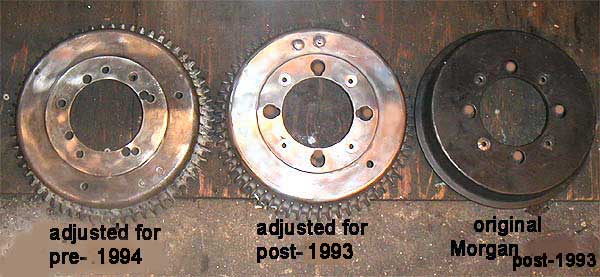
See the one at the bottom of the page..example on the far left..
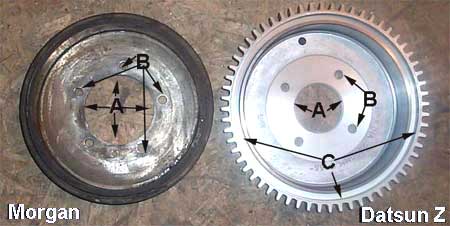
The picture below shows your Morgan drums and the untouched
Datsun beside it.
 There are three mods necessary to get it to fit a car
made for bolt on wheels.
There are three mods necessary to get it to fit a car
made for bolt on wheels.
1.
Increase the size of centre holes "A" to match those on your Morgan drums.
You will find that the two sides of the car are possibly slightly different.
(smile)
2. Drill the new bolt holes "B" The Datsun comes with
four and none will fit. It is best to overlap one of the new holes as best
as possible over one of the old holes and then others will be clear
of the originals. It is a small thing but you can have him place the countersunk
fixing screw for the drum as close to the overlapping hole as possible.
One has to play a bit to get it all right.
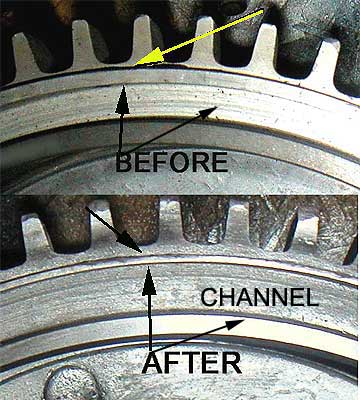
3. One must remove one half the thickness of the inner
side of outer edge of the groove around the perimeter of the drum. That
sounds complicated but it is clear when you are looking at the drum.
Simply put, the groove is not wide enough to accommodate the Morgan back
plate...with this mod it will be.
P.S. If you are using your old brake shoes, you will have
wait a bit of driving for the shoes to adjust to a new curvature of the
drums depending on the difference in wear between the Morgan and the Datsun.
If you are lucky enough to find new Datsun drums and the spirit so moves
you, have one of the companies (i.e.Porterfield) making carbon kevlar brake
shoes to make you up a set to match the curvature. You will be surprised
at the braking improvement.
NOTE: With the older brakes and brake adjusters you should
back off the brake shoe adjustment before fitting the z-drums as you would
with any new drums and then re-adjustment as you would normally. If the
brake shoes are still too tight you can remove the shoes (if you know how)
and file a tiny bit off the contact points at the ends to give you
a little more leeway.
.Post-1993 Self-adjusting rear
brakes (wires)
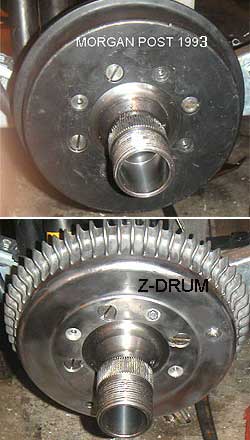
 The post-1993 self-adjusting rear brake made-for-wire-wheels
Morgans have much less machining. The Morgan drums on these come already
made for 8 holes (four to give clearance to the bolts holding the assembly
to the axle and 4 to hold the drum on the assembly).
The post-1993 self-adjusting rear brake made-for-wire-wheels
Morgans have much less machining. The Morgan drums on these come already
made for 8 holes (four to give clearance to the bolts holding the assembly
to the axle and 4 to hold the drum on the assembly).
With the almost identical bolt pattern on both the Morgan
drum and the Datsun Z-drum there are no excess holes left as in the earlier
cars. That will leave you with a comparatively "clean" result.
| IMPORTANT WATCHPOINT 5:
I am a perfectionist. When I found my first set of new (from
Nissan) 30 years ago (then for a pre-June 1993 Plus 8, I had the holes
drilled as described here and asked the best professional welder I
knew, to fill in the old original holes. DISASTER!! Despite all
precautions the bi-metal nature of these drums runs a 50% risk of ruining the entire drum.
Do not try it. |
I should note that on three Morgans and 400,000kms I have
never had a problems with these modifications.
1955 Plus 4
by Harald Sakshaug
Pulled the front brake drum off my 55 +4 yesterday, and
preliminarily fitted the disk wheel hub with the drum back plate and shoes
in situ. It fits. Then took the front drum brake, disk wire wheel hub and
the Nissan Z240 aluminum drum to my workbench. Lads and ladettes, it is
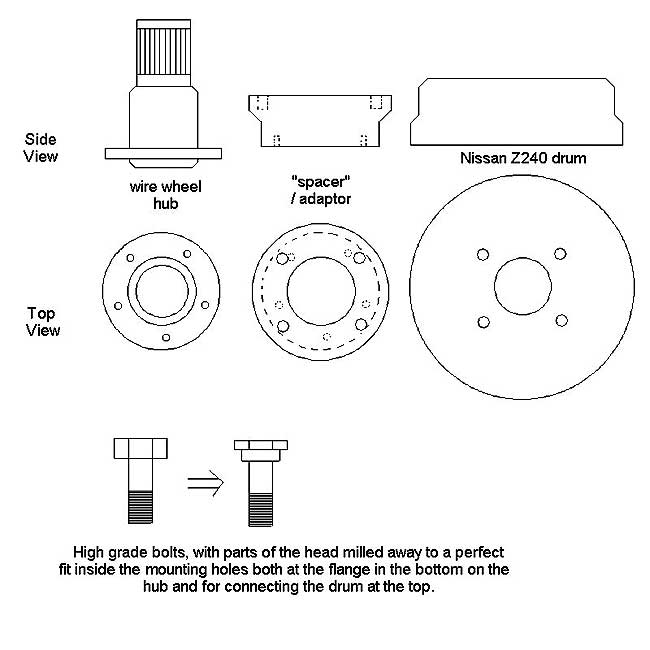
indeed possible to make a spacer which will fit on the disk wire wheel
hub so I can mount the Nissan drum to it.
Hey presto, I have wire wheels on my +4 without having
to convert to disk brakes. Much cheaper, and much less altering to the
original layout. When I want to go stud wheels again, I just pull the wire
wheel
hub and remount the studded one.
I'll pop down to the local metal wizard shop for some
lathe work to the drum itself, and have them to make two cylindrical spacer
rings (one for each side) to fit over the wire wheel hub. This spacer will
be mounted on the flange of the wire wheel hub with the 5 connecting holes.
Then the Nissan drum will be connected on the top of that spacer with the
four bolting holes in the drum.
The room behind the wire wheel hub is an issue, and I
have a general idea how to make the connections, which is attached to this
email as an image.
If anyone out there has ideas, opinions or just want to
address me for advice, please do. It would be welcome. Harald
BACK