 ADJUSTMENT & FILLING
ADJUSTMENT & FILLING
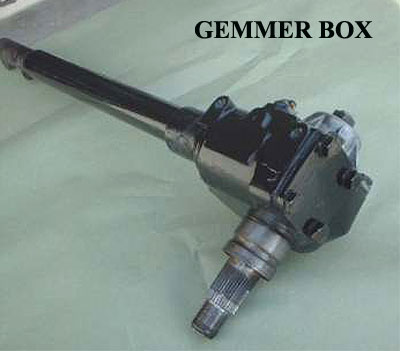
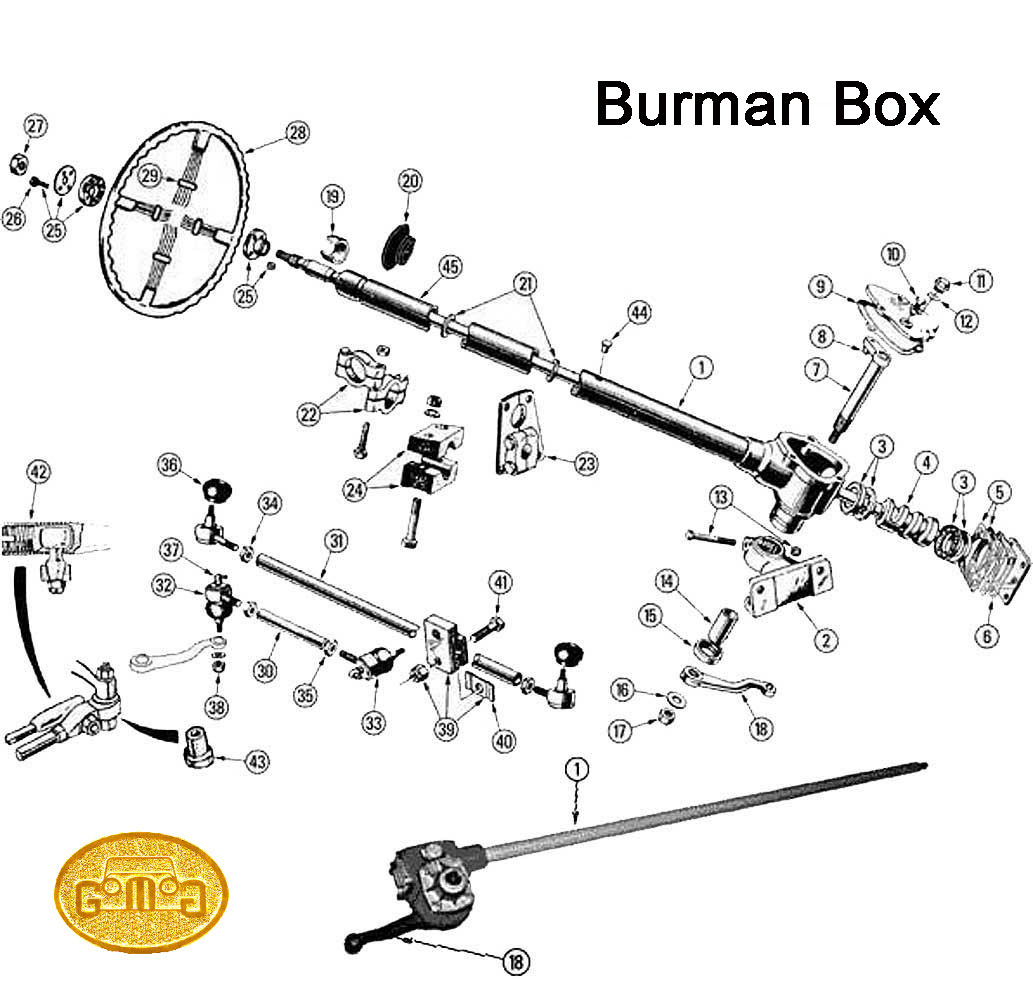
The Gemmer is a recirculating ball type steering box. It is adjusted in a similar fashion to the Burman.
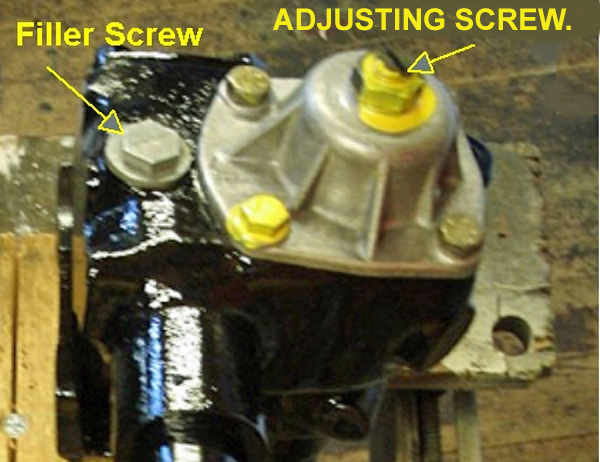
At the top of the box
you will find a screw with a 19mm locknut. One loosens the locknut and adjusts
the play-out with the screw and then re-tighten the locknut. PLEASE READ
ON.
| WATCHPOINT: The box must only be adjusted when it is centered dead ahead. When it is properly centered you must detect/find a single adjustment point which has less play. You determine this point by turning the steering until you feel the slightest hint of resistance at that special point. You then can adjust the play out AT THIS POINT ONLY. You see, it is a feature of the Gemmer box that play increases the further from this center point one turns. That is how they are designed and if you attempt to remove the play at another point, you can even cause damage to the box or inhibit your steering. |
Gemmer steering boxes are best lubricated with a high-viscosity, non-additive gear oil such as SAE 140 or SAE 90 mineral oil. However, due to common leaks, many users prefer a thick, semi-fluid lubricant like a NLGI 0 or 00.
| WATCHPOINT: As is the experience with all gearing applications, the thicker the lubricant, the smoother the function feels but the more sluggishly the interact and/or shift/turn. However, considering the torque created by the length of a steering shaft, in this instance, you won't notice. |
|
 |
Filling a Gemmer with NLGI 0 grease, a semi-fluid grease, is a common method to eliminate leaks in older manual steering boxes while providing better lubrication than heavy grease. NLGI 0 is ideal because it is soft enough to flow, unlike NLGI 2 wheel bearing grease, which can harden and leave gears dry.
Here is how to do the job:
1. Prepare the Vehicle:
Safety: Secure the vehicle on jack stands or a lift if necessary.
Clean: Thoroughly clean the top of the steering box to prevent dirt from entering.
Turn Steering: Turn the steering wheel all the way to one side (e.g., full left) to ensure the internal components are positioned to allow the grease to enter, and to make the filler plug accessible.
2. Access the Steering Box:
Remove Plug: Remove the filler plug (usually a hex bolt or square-head plug) on top of the steering box.
Optional - A Grease Nipple Fitting: For easier application replace the filler plug with a grease fitting (zirk fitting). This allows the use of a standard grease gun to pump the grease in.
3. Filling with NLGI 0 Grease:
Use a Lubricant Gun/Pump: Since the stuff is semi-fluid, you can use a grease gun, a squeeze bottle or mechanical syringe.
Pump/Pour: Insert the nozzle into the filler hole. Pump or pour the grease into the box.
Monitor Levels: Continue filling until the grease reaches the bottom of the threads of the filler hole.
Purge Air: Turn the steering wheel lock-to-lock several times to work out air bubbles, then add more grease if necessary.
4. Reassembly
Clean and Replace: Clean the area around the filler hole, reapply sealant or PTFE tape if necessary, reinstall the filler plug or zirk fitting.
Cleanup: Wipe off any excess grease that was squeezed out during the process.
WATCHPOINT 1: Unlike regular grease, NLGI 0 will not harden in the box and still provides better flow and lubrication, making it ideal for worn seals in vintage cars.
WATCHPOINT 2: Don't overfill: If you add too much, it will work its way up the steering column tube to lubricate the needle bearing. WATCHPOINT 3: If the grease is too thick to pump easily, place the container in hot water for a few minutes to make it flow better.
THE GEMMER BOX: OVERVIEW AND HISTORY
by Lorne Goldman 2014
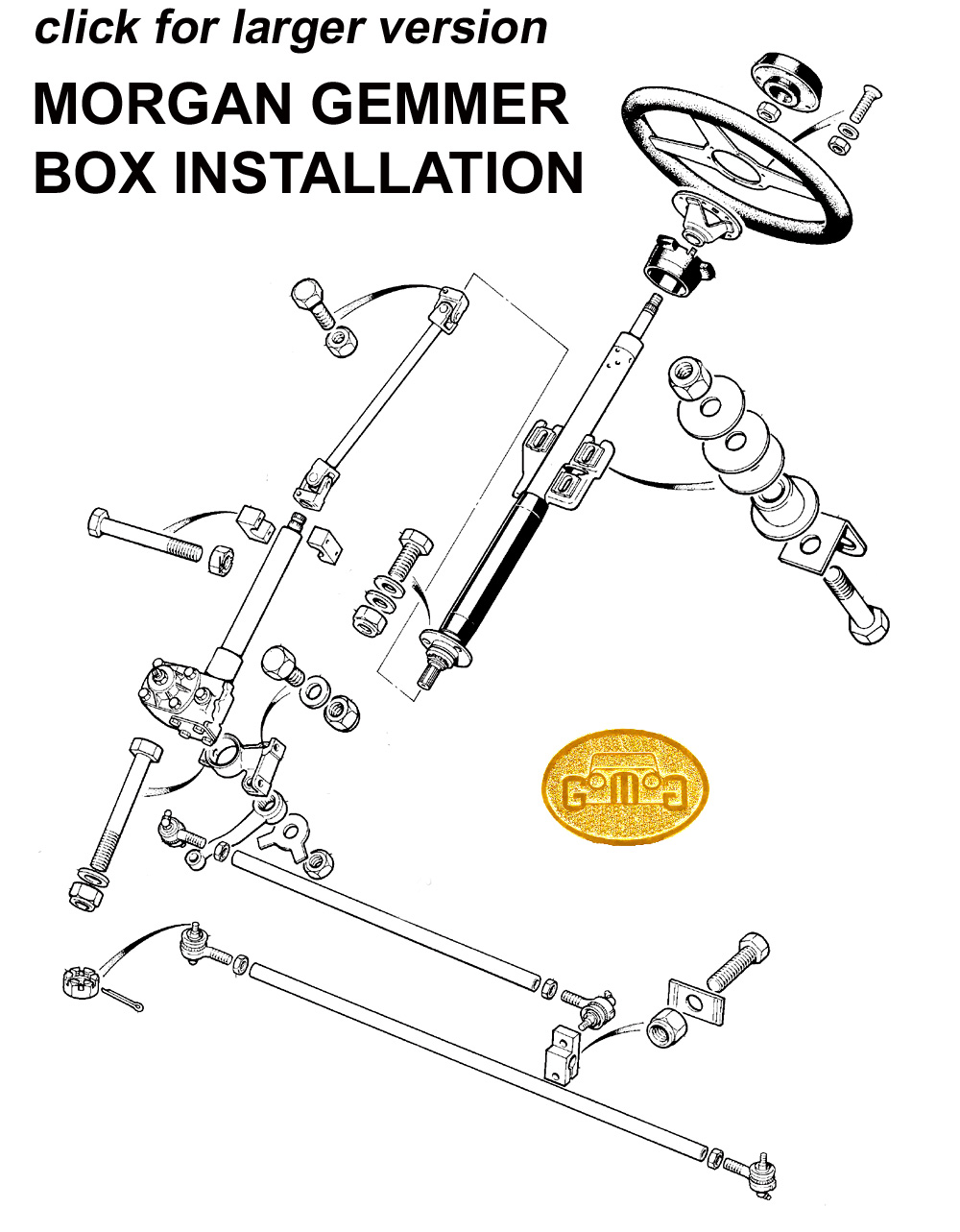
The Gemmer Box is a lovely gift to the Morgan community, both for the Morgans which had it installed and those who have it retro-fitted. It cured many Morgan front end ills of the cars that game before as it was so precisely made that it removed much of the unnecessary play allowed by earlier steering boxes..which gave the marque a less-than-perfect front end reputation. The Gemmer may not have ended the era of the Malvern Dance, but it limited the spread of it. Only the very crankiest of oldtimers would compare earlier steering to the Morgan Gemmer. Read the wonderful Mr. Jean Frederic Frot. The Cam Gear Plus 8s are almost impossible to park and have all the steering grace of an old heavy lorry. Most importantly, the Gemmer, unlike the later Rack & Pinion systems, can be easily be retrofit to earlier non-Gemmer Morgans....a blessing!
The Morgan Gemmers were first fit to the Plus 8. These were seriously difficult to steer using the older steering boxes. The Gemmer resolved that until 1983 when the first Jack Knight R&P were fitted as an option if you also optioned for the EFI option as well. The R&P became a stock feature for the Plus 8 in 1986. However, the Gemmer became a stock item for the 4/4and Plus 4s in 1986.
How did Gemmer magically appear for Morgan just when needed? And who is Gemmer? The Gemmer name has been around since the inception of the Detroit auto industry. They began in Wabash, Indiania..but then moved in with their market in Detroit in 1907. It's small plant, long abandonned and sits in the shadow of the much more famous Packard Motors, but anyone who has visited Packard's ruins has had a view of the old Gemmer watertower or smokestack. Gemmer steering systems can be found on many older automobiles, farm machinery and other industrial equipment over many decades. They invented the first stock power steeing unit, the Hydraguide in 1951, which Chrysler fit to their cars in order to manage the weight of the Hemi V-8.
In the 1950s, the Gemmer patents were licensed to a French company and used to make steering gear for Alfa, Land Rover and Facel Vega and some other high-end European makes along with other wheeled machinery. They supplied steering systems under that the Gemmer name to the agriculture and storage industries, using the original Gemmer worm and roller. By 1980, the existing steering supplier to Morgan was making noises about ceasing supply as their market was too small. Additionally, the tyre stance had widened along with the tyre patch, making steering of the Plus 8 even more cumbersome.
Happily, as so often happened in the the HFS/PM eras, a lucky contact appeared. One of the well-known Morgan enthusiast Frot brothers (sons of the famous Jaquie Frot) had a good friend by the name Adrien Davis who was working for Gemmer (France). Jean-Christophe introduced Adrien to Peter Morgan. Some weeks later, a crew of unilingual Frenchmen arrived from France at the Morgan Factory in Malvern. The Works staff who were there remembered being bewildered at the rush of a strange langage they could not understand and the constant stream of gestures and exclamations. A few days later, the French team packed up and disappeared as fast as they had come (with many Malverians making the sign of the Cross in their wake!) But sure enough, after a short time, the Morgan Gemmer appeared in Malvern. It fit perfectly and was an instant improvement. It is a variation of a unit used on a popular fork lift of that time. No one has ever hear of a problem with a Gemmer.
The Gemmer remained a Morgan stock part until all models adopted the R&P system...yet another tale. More importantly hundreds of units were retro-fit and making Morgan-driving a more pleasurable and reliable experience for early Morgans. Sadly, aside from a windfall supply in 2010, the Factory no longer can supply the unit.