 BATTERY
The situation here is that your car won't start. You turn the key to start, and you get nothing. This procedure is only for those times when the starter doesn't even try to crank the engine. You turn the key and you get nothing or maybe a click and some dimming of the idiot lights.
Here's a troubleshooting procedure for you.
BATTERY
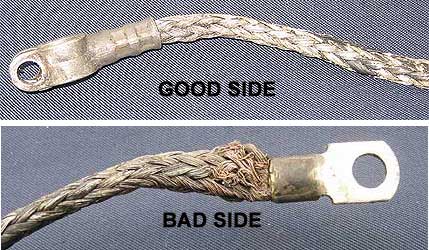
Your first goal is to determine the state of charge of your battery. Turn your headlights on and see how bright they are. If they are of normal brightness then you are probably OK. If you have a voltmeter, put it across the terminals of the battery. A fully charged battery will read around 12.5 volts, a dead battery will be less than say 11.8 volts. If your battery is dead, charge it and then proceed to the next step. The battery earth could also be bad or marginal. This will mean it tests correctly if it is not engaged, but experiences a steep drop (often only when the engine is hot) as soon as you engage the starter. That will make the starter turn slowly or not at all or reduce the voltage remaning to the point where the coil cannot prodcue a spark. A braided earth strap could look great on one side, but have many broken stands on the other. Here is an example in the image.
IGNITION SWITCH
Next you want to find out if your ignition switch is sending power to the solenoid. A preliminary check for this is if your idiot lights dim when you turn the key to start, that's a good indicator that the ignition switch is functioning properly. To check for sure, get under the car and disconnect from the solenoid the wire that comes from the ignition switch. It connects to a push-on spade connector on the solenoid. Fuel-injected cars have two spade connectors on the solenoid. In that case, the ignition switch wire will be the heavier of the two wires. Disconnect the wire, then use your voltmeter to check for 12v at that wire. Put the positive lead to the wire and ground the negative lead, then have your helper turn the key to start. When your helper does this, you should read 12v at the wire. If not, suspect a defective ignition switch or a break in the wiring (or disconnected) wire between the battery and ignition switch or ignition switch and starter. Repair and try again. If you do have power at that wire, move on to the next step.
STARTER MOTOR
Next you want to see if the problem lies in the starter motor itself. Looking at the back of the solenoid, you will see two big post electrical connectors. What you want to do here (TRANSMISSION IN NEUTRAL -- PARKING BRAKE ON!!!!!!!!!!!!!) is grab a big screwdriver or a pair of insulated pliers. Touch only the plastic or rubber handle. You want to take this tool and short across the two big post terminals. Be prepared for some sparks, but hold the tool up there until you make a good connection. What you are doing here is connecting the battery directly to the starter motor, WITHOUT engaging the solenoid. So what should happen is that the starter motor will spin but will not crank the engine. It should sound like a regular electric motor, no gravelly or strange noises. If it does not spin or sounds really bad, have it rebuilt. If it works like it's supposed to, the motor is good so move on to the next step. See HERE
SOLENOID
OK, you're now starting to run out of possible problems! The next test is to see if the solenoid is working. Here's how this goes. First, TRANSMISSION IN NEUTRAL -- PARKING BRAKE ON!!!!!!!). Look at the back of the solenoid. There are the two big post terminals you just played with. Look at the one on the right. You will see that there is simply a short heavy braided wire attached to it that runs down into the starter motor. What you want to do here is spike the positive lead of your voltmeter into this braided wire and ground the negative lead. Then have your helper turn the key to start. When your helper does this, you should hear a clunk and measure 12v with your voltmeter (additionally, the engine should be cranking as this happens). If you do not measure 12v, your solenoid is not activating and is not sending power to the starter motor. I had a case on my van where the solenoid would clunk but I was only measuring 1.5 volts at that braided wire, and the starter motor was not turning. I had the solenoid rebuilt at a shop and that solved the problem.
If you do not measure 12v at the braided wire as above. then there is a strong possibnlity your solenopid is defective. Remove the starter and have the solenoid rebuilt -- if your starter motor tests fine. I took mine to a local automotive electrical rebuilder and that solved my problem. Or you can go whole hog and exchange your starter/solenoid assembly for a rebuilt model or new model bought at a parts store. This, however, can be quite expensive.
NOT STARTING OR CHECKING
YOUR BATTERY
by George Dow on eMOG
Justin, seems that there may not be enough volts in the right place at the right time. A simple statement, though resistance can play a part in making a good battery look duff.
Resistance can be many things in a Morgan, such as slack or corroded battery terminals, starter terminals or earthing connections... Battery to chassis, or bulkhead and chassis to engine.
It is good to use your voltmeter as a guide, though car voltmeters can be notoriously slow to react to variations on voltage, dependant on its type. Of course if your battery connections are the problem, the voltmeter will read low, and the battery could be serviceable! It may surprise you and others to find out that, while cranking, a voltage of 9.6 to 10Volts is average on a battery in reasonable condition.
If there is resistance, the resistance will get warm if you hold the key in the "start" position. Thi is not a wise move on an electronic car with a bad earth, as the current will be trying to find an alternative path and can FRY things in the process!
Put the headlights on full beam and try to start the car, if they dim greatly perhaps you have a battery or connection problem or the starter is jammed (unlikely). If they do not then it is likely that you have a starter problem.
If you have a starter problem again it could be the chassis to engine earth, or the connection for the heavy cable at the solenoid. Either of these will get warm if they are dirty or slack. If you are messing with the electric's then disconnect the battery you could damage yourself if you short out those heavy leads with a spanner. Such is the power that it can start a fire in jig time and there are no fuses to save you in that circuit, though metal will melt! Also a dud cell in a battery will generally bubble to the extent it can be heard while loaded with the starter on.
If you are charging your battery. Measure it`s terminal voltage at the start of the charge. Using a low current and a long time to charge is generally preferable to a high current in a short time. When you take the battery off charge let it sit for at least a half hour disconnected from everything.....hope your car is not one of those that returns the ECU to factory settings when the battery is disconnected and what about your stereo codes?
After you let the battery lie for a while disconnected....
if it reads 11.9 volts it is only 20% efficient
12.12v 40% efficient
12.3 volts 60% efficient
12.52 volts 80% efficient
12.72 volts 100% efficient
It must have been fully charged and allowed to stand alone
for these voltages to be a reasonably accurate efficiency test....... Me
? I would not want a battery any less than 80% efficient before winter
comes along. Please Look HERE
CHARGING A VERY FLAT BATTERY
by Lorne Goldman
How does one recharge a deeply-discharged (below 10.5 volts) battery.
Virtually any standard automotive battery charger on the
market will charge a battery just fine. However, most automotive battery
chargers will not charge any battery that h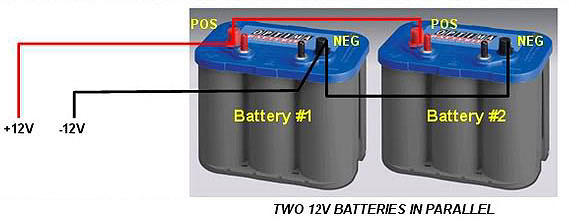 as
been discharged below 10.5 volts. If a standard flooded battery is discharged
below 10.5 volts, there’s often not much of a chance that it will be serviceable
again. However, AGM-style batteries (like the Optima I use), can be recovered
from a
as
been discharged below 10.5 volts. If a standard flooded battery is discharged
below 10.5 volts, there’s often not much of a chance that it will be serviceable
again. However, AGM-style batteries (like the Optima I use), can be recovered
from a 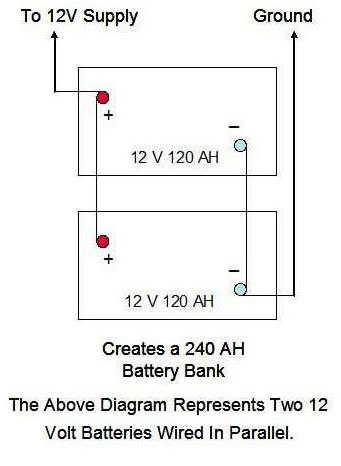 deeply-discharged
state, by using an AGM-specific charger OR BY PARALLEL CHARGING. You can
also try this with any battery...and it might work (possibly supplemented
with incense and ritual chanting).
deeply-discharged
state, by using an AGM-specific charger OR BY PARALLEL CHARGING. You can
also try this with any battery...and it might work (possibly supplemented
with incense and ritual chanting).
To charge a deeply-discharged battery with a regular charger, wire in a second fully-charged automotive battery (12V+) to the discharged one in parallel (+ to + and – to –). Then hook up the charger to either battery, setting the charger at 10-12 amps for 2 hours and monitoring it frequently. When the discharged battery reaches 10.5 volts or more, remove the second battery and continue charging until fully charged. When fully charged, the battery should be tested under load as well (check the voltage on the battery as you engage the starter.).
Yes, I typically recommend charging at a relatively low current, such as 2 amps. But when a battery has been deeply discharged, some sulfation of the battery plates may have occurred. If you charge at 10-12 amps, the higher current will help to break that up. If you have an automatic charger, let it run until the charger indicates charging is complete. If you have a manual charger, estimate charging time by multiplying the capacity (amp hours or Ah) of the battery by 1.2 for a rough estimate of charging time in hours.
In most cases, these steps will recover a higher quality battery and sometimes, it even works with a run-of-the-mill battery. It’s ok for batteries to get slightly warm during the charging process, but hot to the touch or hissing from the battery indicates a short and the process should be discontinued. If you are able to fully charge the battery, but it gradually loses it's charge (without any loads on it) over 12-24 hours, the battery is should be tossed.
If you’d rather not deal with this process, you can always take your battery to a professional who knows AGM technology. Most of them are willing to provide “charge and check” procedures for a small fee and many will provide the service for free.