"The Damper Blades were not fitted to three wheelers
I believe because the large wheels, light weight, and low speeds did not
result in front wheel shimmy.
As the spindle moves up the kingpin over a bump, the spring
will have a twisting motion, this is relayed to the spindle and results
in a slight turning of the wheel. If this occurs at a certain speed. It
sets up a harmonic bounce which becomes a violent shimmy. This usually
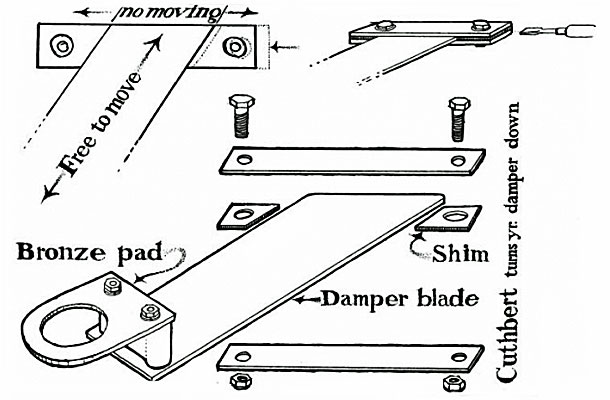
occurs at between 55 and 65 mph. The damper blade is bolted to a bronze
plate fitted between the spring and spindle and, via the blade, is held
to the chassis. Thus the spring can rub on the bronze plate and move but
the plate is held still and none of the springs motion is transferred to
the spindle. Since the spindle moves up and down the length of the blade
can not be fixed. The blade is held to the chassis by being sandwiched
between two flat bars so that the blade can move in and out. At each end
of the approximately 1" by 4" bars are shims which are the same thickness
and material as the blade. These are positioned and pressed up to the blade's
side as guides and the bolts hold them tight so they can not move fore
or aft thusly preventing unwanted (side to side) lateral movement of the
blades.
Both the shims and blade wear since the blade rubs on
the shims every time the wheel moves up or down. As the blades and shims
become worn, their edges lose the height necessary to act as a stop and
they pinch rather than guide (stopping movement entirely). To test for
wear, grab the blade and push forward and back. If a click or movement
can be heard or felt the shims need to be pushed tight against the blades.
There should be free movement in and out, from the center line of the car,
but no movement otherwise. I check mine every time I grease the car, and
adjust the slack out."
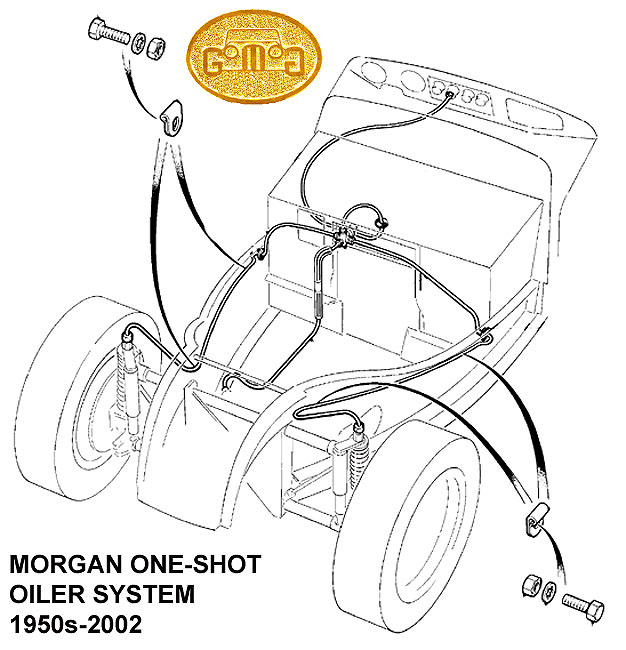 The One
Shot Oiler
The One
Shot Oiler
This is one of the more intriguing (and sadder) stories
of Morgan design. It remained unique only to Morgan as part of the front
suspension from the 1950s to 2002 when it was finally removed. The manuals
of the day suggested that the front suspension be given a regular shot
of oil from the one-shot pedal immediately at start up every 100 mi. In
fact, it did and can not lubricate the suspension as its kingpin exit hole
does not reach the reservoir section within the stub axle. Others suggest
that it is there to lubricate the damper blade plate, but the MMC was quite
clear in their 1920s articles that this plate was a FRICTION damper. Oil
would prejudice that. In any event, all stub axles grease that plate automatically
from a drilled passage coming up from below.
The only thing that testing and experience has proven
is that use of the one shot oiler;
1. can dangerously foul the brakes
2. cover that area of the car with dirty oil
3. offer the opportunity for a broken one shot oiler valve
and/or lines and void the car in minutes of motor oil..to disastrous effect.
4. Dirty the floor around it.
5. Has no remedial effect
| WATCHPOINT: Replacement of the old oiler system with a
grease zirk sadly makes no sense at all. The older passages are not made
for the passage of grease and the grease will NOT go far enough down to
reach anything of significance. The exit hole exits too high to serve the
stub axle grease reservoir. The result of using the oiler passage to feed
grease is to create grease gobs next to your brake disc. |
So why is the one-shot oiler there? It was placed at the
insistence of Peter Morgan (NOT HFS!) who had seen something similar with
Bentley (different design) and was probably tired of hearing stiff steering complaints from owners who never grease their Morgans. Though there was advice against, one does not
argue with the boss, especially a well-loved one. The oiler was removed
as soon as internal diplomacy allowed in 2002. Few, if any experts or dealers
had suggested its use for decades before. It was removed completely..though frankly, the MMC never got that area right.
| WATCHPOINT: Once you are removing the system, do it right.
Remove the oiler lines to the junction on the bulkhead. The pre-1998 cars
feed the pressure gauge from the oiler junction at the bulkhead. You can
replace the gauge with its electrical version. Both VDO and Smiths oil
gauges come in an identical-looking electrical gauge that functions by
electrical signal rather than an oil feed. That removes all risk. Or,
if you wish to keeping the mechanical oil pressure gauge, plug the feeds
to the oiler system at that junction with bronze threaded plugs. Even
so, you would be to change the feed to the junction to an Aeroquip line.
There are many reported incidents of that nylon oil line breaking or melting
with sad result. Happened to me as well! |
In 2007 the MMC replaced the damper plate and blades with
steering races (bearings) copied from the systems of designed by John Sheally, Peter
Mulberry and popularized by eMog in 2001/3. However, the MMC stub axle design proved to inadequately replenish
bearing assembly with grease. To assist in this task, they once again drilled passages
down their kingpins to feed the bearing housing, a wider one that would
specifically feed their bearing system with a large grease nipple atop
the kingpin. Meanwhile, the aftermarket systems noted work well without this passage. Just
grease the lower grease nipple normally and wait for the grease to appear
at the edge of the bearing cup.
See FRONT SUSPENSION LUBRICATION
Steering components
The only remaining part of the front suspension that can
contribute to the vibrations is the steering box and the tie rods.
Borrowing a section from Fred Sisson's book (Notes
from a Morgan Garage), he discusses a problem with the tie rods:
"I found a source of play on my +4 steering.
It is a simple adjustment to eliminate it. The Pitman arm (on the steering
gear box) transfers it's motion to the tie rod (the rod between the front
wheels transverse rod) via the drag link. The ball end on the drag link
fits into a clamp-on fitting on the tie rod.
I noticed that the first motion of the transfer
rod would twist the tie rod about 1/8 of a turn before it actually moved
the tie rod. The ball tie rod ends allow this rod to twist that much.
By loosening the clamp and rotating it on the tie
rod slightly, the twisting motion was eliminated, thus tightening the steering
action some.
I've checked a friend's +4 and found the same problem.
You might want to check your car too. Just have a friend move the steering
wheel while you watch the action of the tie rod. With a little experimenting
you will find a position for the clamp that will not twist the tie rod.
Fred Sisson 1992"
Morgan Classics have had 4 different steering assemblies (at the time of this writing).
The first 4/4s were similar to that on the Trikes. They simply had a reduction
gear mounted on the steering column. This was quickly change and a Cam Gear then a Burman
worm and nut box was installed. This was used up until the later 1980s
when the steering box was changed to a Gemmer box.
The Burman box has an adjustment for loading the worm.
Also check that the bolts on the top of the steering box have not vibrated
loose. To check the worm loading, jack up the car and disconnect the Pittman
arm (the big heavy steel arm coming from the bottom of the box) from the
drag link (cross bar that connects to the tie rod). Carefully turn the
steering wheel from lock to lock. There should be just a slight (ever so
slight - about 12 in. pounds) increase in the force required to move the
steering wheel through center. If not, loosen the locking nut on the screw
adjuster located on the top of the steering box. Turn the adjusting screw
slightly, tighten the locking nut and re-test. Once there is some resistance
felt, no further adjustment is required.
Mating New Bushings to
the Kingpins (updated 2014)
by Lorne Goldman
Morgan stub axles are not made to a dimensionally consistent standard. In welding the kingpin tubes to the axles,
the Factory warps the kingpin tube and they do not correct the anomalies they create. Ergo, except for Devol-bushed cars made between late 2001 and 2006, each tube is can be different. Instead of correcting the tubes to a standard (which would
require a one time honing or reaming of the tubes themselves
to a common ID and matched alignment of both ends). Without a common ID
and alignment, resultant fit bushes cannot be used and we are forced to
align the bushes each time we replace them a sad waste of time fraught
with the possibility or making an error.
If course it would be much safer, easier and less
costly to simply press bushes
in and expect, automatically, a correct clearance and/or alignment of
top and bottom. But, as Morgan has planned it, you can have one bush
askew one way and the other end askew another way along with varying
clearances after the bushes are force-pressed into the lopsided tube,
inconsistent ID tubes, making the kingpins bind and seize. So properly sizing and aligning new bushings to
the kingpins is absolutely key to
the success of the job. So once the old bushings have been removed and
the new ones forced in, they will have to be
mated (aligning the bushes with each other and the kingpins and also
machined so that the interior diameter of the
bushes has the right clearance for the kingpins). This will require
either that you purchase some special tools aka
a line reamer) or find a machine shop that will do the work with more
sophisticated equipment, (computerized laser guided honer.)
These
are the two methods of obtaining a correct bush fit. One is to use a
line reamer, the other is to have them computer guided honed.
The consensus of opinion is that the honing is preferred as a better
and a computer-consistent precision fit
can be attained every time. I have tried both ways, a few times, and never noticed a difference. As well, honing allows for improved lubrication
of the bushes on the same principle that encourages the honing of engine cylinder walls. Knowledgeable owners simply
use hardchromed kingpins and forget such esoteric niceties. I
once had mine done at our nearby a machine shop with a laser-guided
Sunnen honer. $20 per axle. However, I admit to using a line reamer
whenever I am faced with bronze bushes....much more convenient.
THE TEST OF A PROPERLY DONE JOB IS THAT THE KINGPIN, PLACED IN THE STUB AXLE AT THE TOP, WILL DROP SMOOTHLY RIGHT THROUGH THE STUB AXLE TUBE. More owners and machine shops make the clearancetoo little rather than too much.
Hard Chromed Versus Stainless
Kingpins (1998, updated 2014)
by Lorne Goldman
FRONT END LIFE
The
variance in front end lifetimes depends the kingpin material and the
frequency and quality of owner care. I recommend the front end be
cleaned and PROPERLY be greased (properly) every 1500 miles. These
figures come from feedback in my archives, gleaned from
personal and forum correspondence. Be very careful on who you choose to
redo your front end installation and the source of the
hardchromes.
Metal bar stock comes in a variety of grades and features. It is not
only the hardchroming that produces the legendary longevity, it is the
quality of the metal under the plating. If it is too soft, the plating
wears quickly, like the factory's stainless pins.
|
Negligent or sporadic care & without little leather booties and coupled with ANY bush material
|
Proper Care |
| MILD STEEL (MMC) |
3000 to 10,000 miles |
25,000 to 30,000 miles |
| STAINLESS STEEL (ORIGINAL MMC) |
10000 to 15,000 miles |
30,000 to 40,000 miles * |
| HARDCHROME |
40,000 to 50,000 miles |
100,000 + miles
|
| WATCHPOINT: Sadly, the
later Factory stainless kingpins will wear before the bush material
no matter what you use for the latter. Additionally, from the longevity point
of view, it does not matter what bush material you favor, though
different types have garnered the fanatical devotion of religious
zealots. As long as you use the proper hardchrome bar stock, within a
proper installation, the longevity of your front end will satisfy the
most prolific driver. So
you can ignore all the web advice to use only the sacred secret product
found in Lost Inca cities with an installation involving ritual
chanting and the sacrificial blood of innocent virgins. This stuff is
not magic nor rocket science..it is merely misunderstood for a very
long time and that continues to this day. BTW. whatever you do, avoid Suplex...a
$2000 method to cure a $5 problem. I have not been without a fellow
owner that cannot get his car back on the road after a bad
installation since the idea appeared. It DOES have two good
elements to it, namely shortening the overlong rebound spring...a
mistake the Factory mistakenly adhered to from some time in the 1950s
The second is that forces owners or their installers to do routine
maintenance that has been neglected for ages and created the need for a
fix in the first place. :( Frankly the latter makes me happy with it.
ANYTHING that forces maintenance is a good thing. |
HISTORY
For
years, it was mistakenly thought that road grit caused the premature
wear..always in the lower bush. The theory was that water and the grit
formed an abrasive paste that entered the area between the kingpin and
bushes and destroyed one or both. This may well be a contributing
factor, but there has never been any empirical proof. In 2003, with the
advent of Devol bushes, the causes for 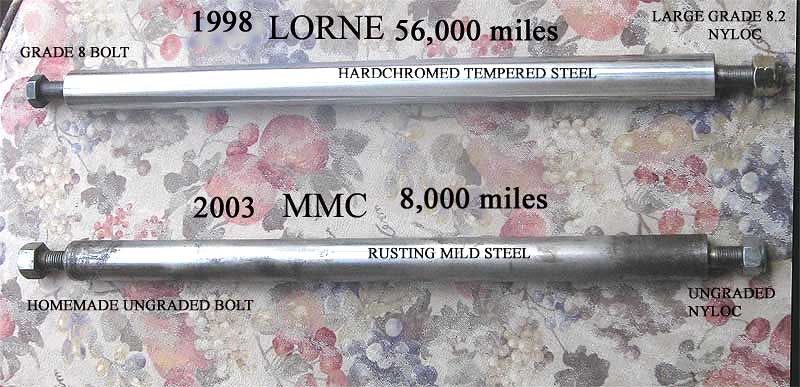 bush
wear became crystal clear. The lower part of the mild steel kingpins
quickly rusts at the bottom, where water accumulates in idle periods.
The rusted exterior surface of the kingpin then acts as a rasp,
grinding away at the bush. Stop the kingpin from rusting and the
lifetime of the bush, of whatever material, is multiplied enormously.
That is why the popularity of hard chromed kingpins has soared in the
last decade, spread by eMog forum testing and there universal success.
bush
wear became crystal clear. The lower part of the mild steel kingpins
quickly rusts at the bottom, where water accumulates in idle periods.
The rusted exterior surface of the kingpin then acts as a rasp,
grinding away at the bush. Stop the kingpin from rusting and the
lifetime of the bush, of whatever material, is multiplied enormously.
That is why the popularity of hard chromed kingpins has soared in the
last decade, spread by eMog forum testing and there universal success.
Actually,
hardchromed kingpins
have a very long history in the
community. They were installed by enthusiasts as far back as the
1950s. I have been using them since 1997.
By chance, in 2004 I discovered a fine fellow in Birmingham (the UK
one) and spent a lovely afternoon with him. He was an 85 year
old Morgan enthusiast and retired master machinist. He had bought a
Morgan directly
from Peter in 1958. After developing the Morgan wobble after 13,000
miles, he examined the wear and then made
himself some hardchrome kingpins from centerless ground (to make the
surface perfect) 1 inch bar stock. He slipped them in and never needed
to redo his front end in his whole tenure with the car and he sold
it..in 1991 with 95,000 miles!
Hardchrome,
also known as industrial chrome or engineered chrome, is used to reduce
friction, increase wear time and provide a corrosion barrier. Unlike
Decorative or Show chrome it is very hard, measuring between 66 to 70
HRC. Hard chroming also tends to be thicker than a decorative
treatment, typically ranging from 0.075 to 0.25 millimeter (0.0030 to
0.0098 in), but can range up to 0.005 to 0.01 mil (0.00013 to 0.00025
mm). Buying 1 inch hardchrome bar stock means that there is no need to
ream or hone more of the bushes than you have to. Like all metals used
in precision hydraulic applications, hard chromium plating is subject
to different types of quality requirements depending on the
application, for instance, the plating on hydraulic piston rods are
tested for corrosion resistance with a salt spray test. As well, the
metal plating varies according to the task you wish to put it to. Steel
offers an immense range of possibilities. Hardchromes have hundreds of
years of history and tested experience. If you go to any hydraulic
application, (such as a earth moving machinery), you will see that the
actuating levers are hardchromed. The immense feedback level and
choices of bar quality make it an ideal kingpin. The eMog group spread
its advantages. I have had three Morgans, with an aggregate of 225,000
miles on them (and counting!). I have used the HC kingpins on them
since 1997 and never needed to do the front end again after
installing them on each car. In a nutshell, they eliminate the need to
ever do a front end job twice, at least in your lifetime. I have run
these hardchromes with bronze, DEVOL and Vesconite bushes.
PM
and the Factory tried chroming pins in the 50's but simply plated them
with Show chrome. But this was an error. Show chrome is very soft and
if the pins are not centerless ground and this type of chroming
actually makes the surface anomalies worse. The soft surface didn't
last more than a couple of weeks of driving. So sadly, the chroming
idea was shelved, but even worse, it became a given to them that all
types of chroming would not work. In 2003, I was consulted by the
Factory when they ran into trouble with mild steel pins and DEVOL
bushes. We went back and forth for a couple of weeks and I tried to
steer them to hardchromes, but I was unsuccessful. They went with
their current stainless steel. Stainless steel also comes in different
grades, though there is a much more limited grade range and a shorter
history for all of them. eMog found that their stainless kingpin grade
wore faster than the DEVOL bushes!
Invariably,
the hardchromes lengthens the lifetime of the front end by many
multiples. Two aftermarket sources sprung up early on, one being Greg
Solow of the Santa Cruz, CA "The Engine Room" who hardchromes Morgan
kingpins (thickening them by approximately .012") and the other being
Machiel Kalf from the Netherlands who uses pre-made 25mm hardchrome bar
stock. As both are not exactly 1", the diameter of a Morgan kingpin,
both must be installed WITH the bushes to ream/hone them to a proper
fit. The  advantage
of 1 inch hardchromed bar stock is that the kingpins can be installed
at any time, simply replacing the ones that are there without redoing
the bushes etc. This will extend the remaining lifetime of the existing
front end without further ado. Though the ideal is to change the bushes
as well at the same time, there is no harm in adding many years onto
what you have with limited work.
advantage
of 1 inch hardchromed bar stock is that the kingpins can be installed
at any time, simply replacing the ones that are there without redoing
the bushes etc. This will extend the remaining lifetime of the existing
front end without further ado. Though the ideal is to change the bushes
as well at the same time, there is no harm in adding many years onto
what you have with limited work.
The reluctance
of the MMC to move to hardcrhomes is explained above. But the
reluctance of the community stemmed from the prices at the time. In
Greg Solow's case, the hardchroming of used pins was very expensive. In
the case, of Europe and the UK, the pins sold by Kalf and which he
supplied to Melvyn Rutter were priced (350£) so much above cost that it
discouraged the larger community on that side of the Atlantic from
considering them. However, in 2001, with eMog encouragement, John
Worrall of Heart of England Morgans began offering them at a normal
markup and the price went down to 40£.One can now purchase hardchrome
from many sources.
It is not a complicated procedure. I make my own out of C1045 or C4140
bar stock at my local machine shop. Anyone with a lathe can do the job.
It was MUCH harder (PUN!) to convince owners to try them!
The reason hardchromes save the bushes is that the stock mild steel
kingpins rust quickly at the bottom, especially if the car is not used
daily. The rusted kingpin surface acts like a rasp and eats away at any bushing
material, whether bronze or (much faster) plastic. The hardchromes keep
a slick, effectively self-lubricating, rustless surface. Unpolished
stainless pins are not as helpful and the grade the MMC sells wears quickly regardless of bush type.
|
The reason hardchromes save the bushes is that the stock
mild steel kingpins rust quickly at the bottom, especially if the car
is not used daily. The rusted kingpin surface acts like a rasp and eats
away at any bushing material, whether bronze or (much faster) plastic.
The hardchromes keep a slick, effectively self-lubricating, rustless
surface. (Unpolished stainless pins are not as helpful.)
However, because of the experience with soft chrome 50 years earlier,
(see above) the Factory moved to stainless steel pins in 2004. This is
a non-typical use of stainless bars and, unlike the hardchrome bars,
they have no track record in this type of usage. To date (2008), there
are many verified reported cases of premature KINGPIN wear with the
Factory stainless kingpins, indicating they may have chosen too poor a
grade of metal. The curious thing is that this wear occurs even with
the plastic Devol bushes when the bushes show no wear!! It is
hoped that the MMC will switch to hardchromes or upgrade the stainless
bar stock they are buying
Hard chromed or stainless kingpins can be fitted to ALL classic Morgans.
N.B. Extensive experience
with the hardchromes has shown that the life of the front end is
extended significantly regardless of what type of bush material is used
or whether they have annular grooves, or lips to prevent grit entry, or
gaiters (booties) or garlic cloves or ritual chanting. Do not
waste your time and money.
|
The DEVOL MORGANS (2001-2006)
by Lorne Goldman (5 updates since 2001)
At
the end of 2001, after a transition period of a few variations on the
theme, the Works removed the one-shot oiler system first installed in
the early 1950s and began using a new kingpin bush material rather than
the traditional phosphor bronze bushes used for almost a century. Many
have refer to them as plastic" or "neoprene" or "nylon" but, in fact,
they are not. They are Factory machined from a polyethylene plastic
called DEVOL S made in Scotland by a company called Devol. They were
brought in to extend the notoriously short Morgan bush life AND to make
the task of bush installation easy rather than the involved task it is
now. Sadly, a number of factors and teething problems intervened,
giving these bushes an undeserved bad reputation. After approximately
2500 "Devol Morgans", the MMC abandoned the idea and returned to bronze
bushes. Subsequently, the MMC stopped supplying Devols and the Devol
cars must use oversize non-resultant fit bronze bushes, or make their
own out of Devol material.
|
WATCHPOINTS:
1.The
primary cause of premature bush wear was never caused the bushes or the
material used for them..it was the use of mild steel kingpins. These
quickly rust at the bottom bush when the car is stored for anything but
a very short time. The exterior surface of the kingpins quickly becomes
as rough with surface rust and acts like a rasp to grind through any
material, especially the new space-age materials. Many moggers, myself
included, have avoided this result for decades by using hardchromed
graded steel kingpins, a item made for this application for the last
two centuries. 100,000+ mile front ends were achieved by our group
since the 1980s.
However,
in a dire situation, the MMC and the aftermarket, like anyone in trade
under pressure, will go for any quick fix. (who can blame them?!) The
MMC switched to a low grade unpolished stainless steel pins and then
changed to bronze bushes when the cheap stainless pins themselves wore
quickly. So did the aftermarket when called on by owners for a quick
solution. THEY came up with mildly oversized bronze bushes so the DEVOL
owners could fit them to their oversized stub axles rather than the
DEVOLS. The Bill Beck common sense dream of resultant fit bushes
forever died aside from a small club.
I have
used DEVOLS for 110000 kms and 21 years. No problem except in the
beginning..when I received my car from the Factory in 2003, mild steer
kingpins and DEVOL bushes. With many other things to do to sort upon
arrival, I left the Factory kingpins in for 3000 miles before
disassembling and putting locally made graded hardchromes in. By that
time, the mild steel kingpins had already rusted and damaged the
original DEVOLS. I swapped in a new set, something that can be done
with resultant fit DEVOLS with the stub axles still on the car,
substituted my hardchrome kingpins and over 100,000 kms on since.
Sadly,
the true story never spread, especially after I ended eMog. (It was too
exhausting for me! It ended with the highest traffic ever enjoyed by a
Morgan forum. to this day) People became fixated with "bush" material
like Vesconite or wrongly assumed the British made DEVOL bushes must be
swapped out..even if not worn. I saw a younger mechanic and retailer,
infamous for advertising his wares on an owners' forum recently
recommend that, whether necessary or not!!! The installation of
press fit oversized bronze requires MUCH more work, as explained above.
It is not totally his fault for the advice..he never knew the story and
was merely hired and trained to make oversize bushes. His knowledge
goes no farther than that. Few without the eMog experience do. I
respect the people who have used Vesconite but when it was put on my UK
Plus 8 (regular, not high lube Vesconite) my front end seized within 100 miles. The installation was done by one of the most respected Morgan mechanics in the UK.
|
In
2002, right after the first cars were fit with Devol, Bill Beck, a fine
fellow and (the last) full mechanical designer at the Factory left the
MMC employ after 25+ years.. By the 2003, reports were coming in from
everywhere that the bushes were lasting as little 3000 miles! A quick
examination showed the cause. They looked for a solution.
I was
contacted by the Factory by the director then in charge, Mark Aston. He
wanted input on hardchromes. They too had reasoned out that any surface
that does not rust should solve the problem. We went back and forth for
a month or so. Sadly, for reasons explained here, in early 2004, the
Company moved from mild steel to stainless steel kingpins. This
is an unusual material to use in this application and there was no
track record for it. By 2006, some owners were discovering that the
kingpins (insufficient quality) were wearing faster than the Devol! But
by then Mark Aston had ceased working for the company as well.
DEVIL's RESULTANT FIT
One super
feature of these bushes is that were made to be a "resultant fit"
meaning that the bushes will automatically have the correct ID once
pressed into the stub axles without the need for reaming or honing.
They also can be removed and inserted with the need for a multi-ton
hydraulic press. To makes this possible, the Factory reamed the stub
axle tube to a standard ID. This was not done and the ID varied
from stub axle to stub axle as their tubes distort when they are welded
to the cast stub axle. We shall call these specially aligned axles the
Devol cars. They were a massively smart move, multiplying Morgan front
end longevity and making the dreaded front end job something any owner
could perform on his driveway. However, Morgan Morgan had problems as
the bushes were not as simple to produce bushes made from the older
bronze stock. The older bushes had no need for precision as they were
individually fitted to each and every kingpin ON THE CAR. And, at the
time the company did not own a modern honer to make the job easy and
perfect. The front end of some cars would seize. Sadly, in 2006, after
approximately 2500 cars they abandoned DEVOL and the entire concept of
a resultant fit in any material. They now do not make or supply Devol
bushes, forcing the DEVOL cars to move to specially made over-sized
bronze bushes which must be specified on order, then reamed and mated
on installation. The 10 minute job at home is now hours with
specialized equipment mentioned for other Morgans.Regular bronze bushes
cannot be fit to DEVOL cars...they create a too-loose fit into the stub
axle. However, since the lack of knowledge of DEVOL caused it to be
eliminated (a tragedy as they work perfectly if hardchromes are
correct) N.B. We found that the cheap stainless the MMC used would wear
much faster than the DEVOLs!!!!
The
Works reported that their original DEVOL test car reached and passed
50,000 miles without discernible bush wear. The earlier bronze could be
expected to last 10,000 to 25,000 miles depending on the quality of
maintenance and kingpin type. In my case, my present DEVOLs (now fitted
with hardchromes kingpins I made locally, have no discernible wear in
110,000 kilometers and counting. However, my first set of DEVOLs,
delivered with mild steel kingpins, were shredding after 3000 miles!
The difference was usage. The Factory test cars are used constantly,
which left no time for kingpin rust to occurs at the lower bush in over
the times the vehicle is dormant for more than a few days.
|
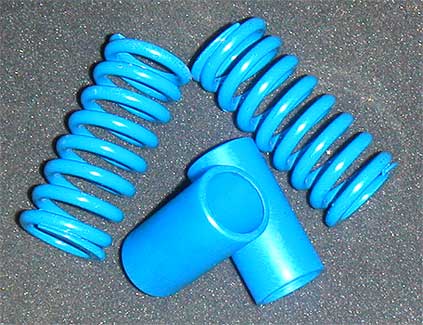
These bushes have a tiny ridge on the ends. This ridge acts as a
barrier to grit, and draws grease into the area between it and the
grease reservoir in the tube (the space between the bushes and the
kingpins). When reamed, this useful ridge is removed. However, after
Bill Beck left, some of the cars began appearing with the bushes
pressed in backwards with the little ridge inside the tube. This acts
in the opposite way, allowing grit to accumulate between the bushes and
the kingpins.
|
 |
SWELLING & SEIZING
Most
importantly, the Factory had an inconsistent experience with the DEVOL
bushes in the UK. This was self-caused but they did not understand that
at the time. And by that time, Bill Beck, the former chief designer had
also left the company. The reaming of the stub axle tube, and the
bushes, made by the Factory from material supplied to them, were not
made to a consistent size, ID or OD. As well, after Bill Beck quit in
2002, the production department changed the amount they were reaming
the stub axle tubes and that changed the resultant clearance. Some
DEVOL cars began seizing the kingpins. ALL reports of seizures are from
the UK. Elsewhere the bushes performed superbly if the kingpins were
changed to hardchromes. The ease of DEVOL installation is a pleasure
taking only minutes to swap bushes rather than hours of precise
machining and specialized equipment.
Devols were
used for 5 years or approximately 2400 Morgans, or more than 1/2 the
trads made in the first decade of the millennium. Because of their
larger tube ID they must continue to use Devol or use oversize bronze
bushes. The company will no longer supply Devols but DEVOL,
a large Scottish company, has distributors all over the planet.
Oversize bronze bushes can be made at a local machine shop. You merely
call the company or a local seller and get a sufficient amount.
For all these reasons, I recommend the following to the DEVOL car Owners whose front ends needs attention;
IF YOU ARE IN THE UK: Use hardchrome kingpins and the oversized bronze bushes for DEVOL stub axles.
IF YOU ARE
OUTSIDE THE UK: Use hardchrome kingpins and DEVOL bushes made for DEVOL
Axles or Hi-Lube Vesconite. They are all easily machinable.
 There are 3 unique items to the Morgan suspension: the
bushings, the damper blades and the one-shot oiler. Replacing the bushings
will require the rebuilding of the front end. (See the article by John
T. Blair - Rebuilding the Front End) However, the
damper blades can replaced without totally disassembling the front suspension and a rebuild for DEVOL cars is very easy.
There are 3 unique items to the Morgan suspension: the
bushings, the damper blades and the one-shot oiler. Replacing the bushings
will require the rebuilding of the front end. (See the article by John
T. Blair - Rebuilding the Front End) However, the
damper blades can replaced without totally disassembling the front suspension and a rebuild for DEVOL cars is very easy.