WING
STAY ISSUES
by Lorne Goldman at
the eMOG Pub June 2005 (Updated July 2012)
 |
Properly
shaped and fitted
wing stays are vital. Without the wing stays, the wings would be
cantilevered
off the thin inner wings, held along most of its length merely by the
tiny
screws at the valence. But since the Steve Morris/Charles Morgan era
began, most of these stays break The forces on them are anything but
negligible.
You don't want your Morgan wings to flap. :) and you do not want these
stays to shear or them to crackthe paint on the outside of the wing.
Poorly shaped or fitted wing
stays cause much damage, metal rubbing, cracking or worse..
There
are two watchpoints.
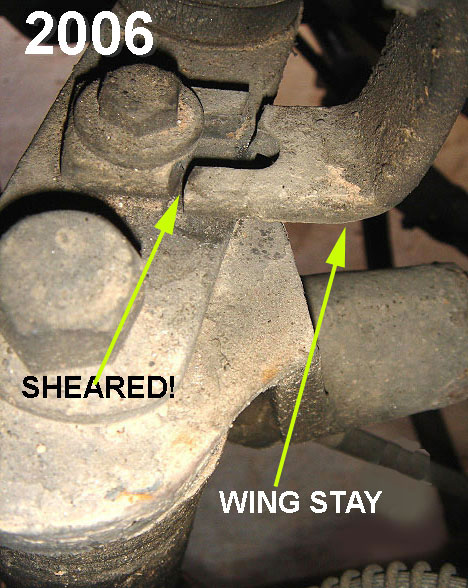
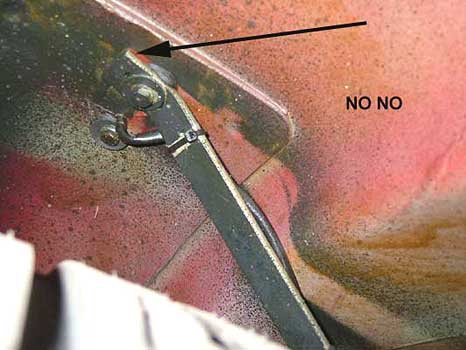
The first is to properly shape the stay at the point stay meets the
underside of the wing and to ride yourself of stays that are slotted at
the bottom. Additionally, the rubbing and the common grounding of the
side
light through the holding bolt to the wing is a combination for an
electrolytic
reaction between the steel and the aluminum that will rot the wing.
I encountered the paint cracking with my first Morgans (1984 and 1990)
and the 2002 sheared the stay at the bottom a numbner of times before
aI recognised the obvious. I was lucky. I still had my earlier stays
from the 1984. I swapped them into the 2002 and haven't had the same
issue sifor 23 years.
|
 |
 Sadly, since Peter's passing (2003), every effort at the
Factory has become based on cost in order to cut down production time and the need for expertise.
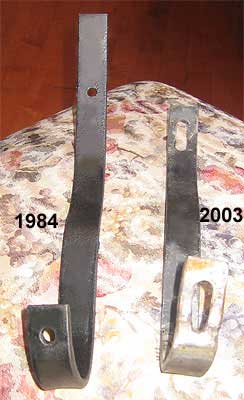
In this area, the Factory production department began, in the early 2000s,
to slot the stay's bolt holes to save time fitting them to each car as
no two Morgans are exactly alike. However, the slotting allows the
stays to shift, and wing/stay damage became epidemic since then. With my
first Morgan,
Sadly, since Peter's passing (2003), every effort at the
Factory has become based on cost in order to cut down production time and the need for expertise.
In this area, the Factory production department began, in the early 2000s,
to slot the stay's bolt holes to save time fitting them to each car as
no two Morgans are exactly alike. However, the slotting allows the
stays to shift, and wing/stay damage became epidemic since then. With my
first Morgan,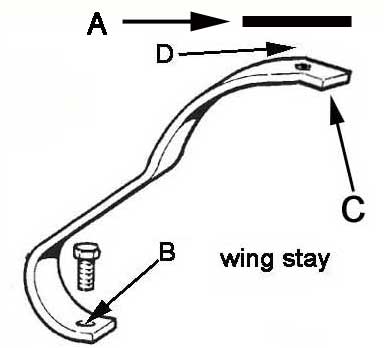 I went years with no stay problems and then, when my car
returned from the Factory in 2003, my new stays cracked five times in two
years before I diagnosed the issue with the slots. The Factory sells the
newer problem causing stays only. I switched them for unslotted stays, old ones I had from the 1980s before Steve Morris' shortcuts began and
I haven't had an issue since...in 18 years.
I went years with no stay problems and then, when my car
returned from the Factory in 2003, my new stays cracked five times in two
years before I diagnosed the issue with the slots. The Factory sells the
newer problem causing stays only. I switched them for unslotted stays, old ones I had from the 1980s before Steve Morris' shortcuts began and
I haven't had an issue since...in 18 years.
With a strong arm, a big
hammer, a drill and a table vice, these stays are not difficult to make
and/or shape perfectly by any owner. And those with the newer slotted stays
would be wise to switch to made-to-measure stays, like they had in the
earlier Morgan eras and everyone would be prudent to make sure their stays
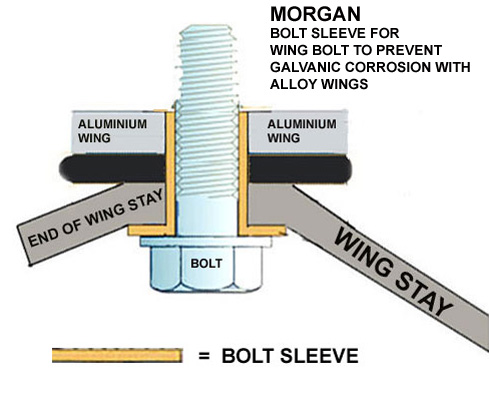
are shaped like the diagram below. 1. The stay must be flat where the lower
bolt is fitted. 2. The stay must rise up to the upper bolt and touch only
the wing only at D after which it stay must immediately curve down (C).
(3). Place a 1/4" thick rubber washer between the stay and the wing (A).
4. Coat the bolt with silicone to prevent steel and alloy contact. (One
can also use a plastic sleeve over the bolt.)
| WATCHPOINT: Beware.
For those of us with later Morgans (post-2000ish) and who do not tend
themselves for their Morgans, though any Morgan dealer who does any
servicing since has seen this problem over and over, some will sell and
send you the same slotted stay/support when yours breaks. Waste of
money and a recipe for another frustrating experience, Additionally,
only an experienced Morgan dealer will know how shape and install them
though the right way take no extra time. Before purchasing, ask whether
they are sending you another slotted stay. |
BRIGHTER WING LAMPS
by Lorne Goldman and André Koopmann
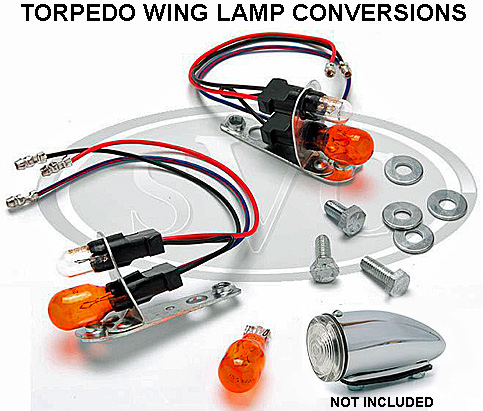 |
If you wish to keep your original look, but also have brighter lights for your torpedo side lamps.The mounting plate is
galvanized steel, with a 21w amber capless bulb and 5w clear capless
bulb. They can supply the 21w capless in clear if required!
Look into this conversion kit from Stafford Vehicle Components of Malvern, England.
|
BETTER PLINTHS
by GoMoG
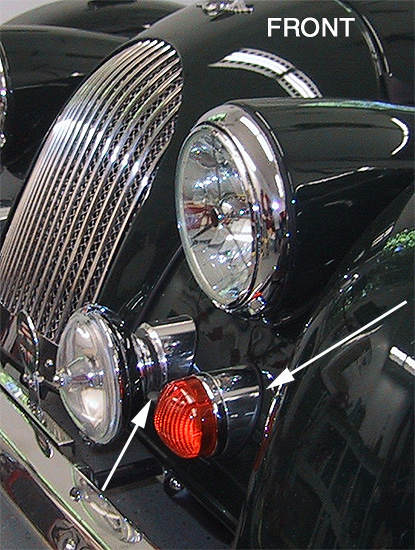
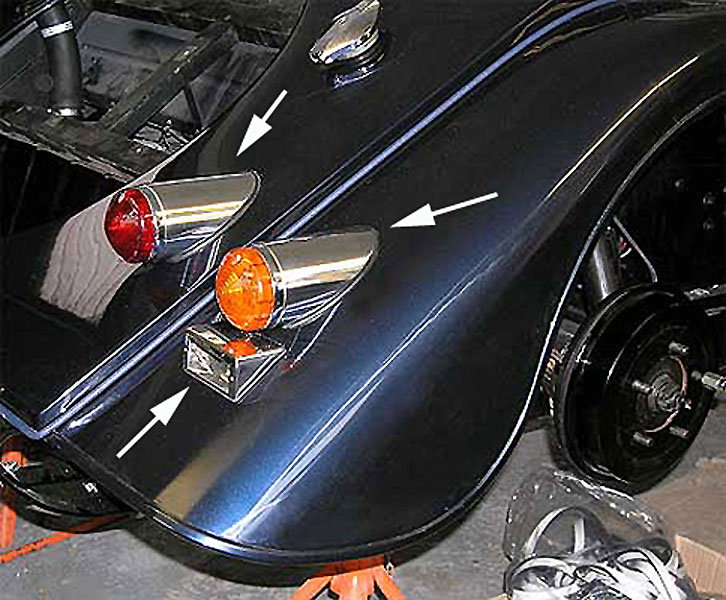
Plinths (say that 5 times
quickly without tripping on your tongue!) is the name for the bases Morgan
uses for the indicator and brake lights places on the
rear wing and the two smaller version in front for the indicator lights.
Sadly they are made of a cheap plastic that are either chromed or painted
at the rear and left black in front. They are delicate and can break.
The constant expansion and contraction of the plastic with temperature eventually causes the chrome or paint to bubble and/or crack.
However,
better quality products
are available. For example, for two decades, John Worrall at Heart of
England Morgans offered these plinths (for both front and back) in
high quality mirror
polished stainless. He also offered spot/fog lamp bases for those of us
who wish to have them fixed to the wing rather than hanging on bumpers
or badge bars. Melvyn Rutter also offers chrome-plated bronze plinths for
the rear for many years. But the chromed softer metal is much more delicate and less long wearing but
they are very pretty as well. I have used them both.