SHOCK SHOOTOUT!
KONI vs WOLF vs NEW ELMS (nee Rutherford AVOs) vs SPAX vs GAZ vs BILSTEIN (revisited January 2, 2025)
by Lorne Goldman
In General
There
is a lot of confusion about shocks..perhaps more
so in our community because of their are fewer of them and their
super low weight is unusual. As well most shock buyers sadly
follow the GoMoG Law of Expenditure: The likelihood of
a car enthusiast reviewing anything he has already purchased with passionate approval is directly
related to how much money he spent on it."
I
can tell you with certainty, after 450,000 kms in Morgans that there is
nothing basically wrong with Morgan trads and their
suspensions. That seems amazing as they are so simple! But simple or
not, they must be understood, sorted and then maintained (a
bit). Once that is done, they are downright sensuous. But each
Morgan,
with their flexing chassis, is different from every other. The secret
is tweaking them until the reflect their owner. One size does NOT fit
all. But between tyre choices and suspension tweaks, you can
transform any Morgan trad.
Adjustable Shocks
Firstly, why adjustable shocks and why not? Springs and tyres
are the first line of defense against road impacts. Shocks aren't. If you
are trying to use shocks to cure suspension problems or stop you from bottoming
out forget it, aside from Wolf Performance shocks, though New Elms have internal bumps stopped IIRC). However, shocks can make driving a far more comfortable
experience. Shocks are first and foremost harmonic balancers. Their goal
is the change the harsh oscillations of a road impact into something we find
pleasant..even fun.
Like any instrument, each car model will react and resonate
differently as a function of its structural dynamics, springs and tyres.
Each car model, depending on its shock angling, will operate well with
only few shocks unless it is one of the more widely produced mid-range
set-ups. Morgans are not widely produced. Neither are they even close to
a standard set-up. There are others like Morgan. In such a case, an adjustable
shock becomes wise option for a shock manufacturer can have one type can
suit many cars. Adjustable shocks also allow suppliers to mitigate inventory
costs.
However,
adjustable shocks not originally made to refine suspensions and they
can lead to owner silliness.
Most manufacturers ease their inventory and manufacturring costs by
making their approximate many different cars' needed by allowing
their dampening rate to be adjusted. That feature disappears as soon as
you bottom out. "Morgan" shocks will normally arrive
in whatever setting they have they feel is closest to a Morgan ratd's
needs. You should be very reluctant to change. As the ability to adjust
disappears after the shocks
bottom out the first time or over a short period, you don't get
any refinement time. Use the wrong setting
and you are stuck with it!
Only two shocks are commercially made for Morgan trads. New Elms and Wolf.
They offer a range suited to Morgan trads. AFAIK, and I have tried
all but one type here, the rest have adjustability as a production cost
saver.
| WATCHPOINT: Front Shocks: After 5 sets of
shock/damper types tried in the front of my Morgans and the same in back,
I have come to a conclusion. The right choice of shocks has far more of an effect
at the rear (cabin comfort being the key point) than the front (merely neutral front end behaviour
and handling asssuming your front end is working as it should). Once you have the right length shock with the right travel
areas and dampening, different front choices (2 choices)don't make much difference
in my opinion. However, the wrong or aged shocks can have a great
negative effect for the front. Additionally, original-type Morgan rears can vary enormously in behavior, especially after the springs have aged and sagged.
So many of us ride on sagged springs at the rear. And there was a
long period (appr 2003 to 2015 and continuing to date) where MMC rear
springs collapsed in no time. :( I have seen so much owner-contrived
weird stuff happen to fix this. |
PLEASE NOTE that I only speak here to the following companies offerings for trads .
NEW ELMS (orginally Rutherford AVOs) updated 2024
I
sourced the information here, directly from David Rutherford.
RECOMMENDED SETTING REAR = SOFTEST SETTING which they will arrive in. Do not change
this. If you do, buy other shocks.
RECOMMENDED SETTING FRONT = Whatever
you think gives
you the least amount of steering wheel feedback. Proper feedback can be
defined as a full not and one half after hitting a road anomally.
In the cases of Spax, Koni, Gaz, Biltstein or others, their shocks offered
are stock items, not specially made and adjusted to the needs of a Morgan.
They all miss the mark slightly. In contrast to this, in 2002/2003, the Morgan famous aftermarket suspension guru,
David Rutherford, back then as frustrated with the offerings as I was, spent some time with AVO, then a small but well-respected
shock maker to come up with a better "fit". It worked!
David
made a contract with AVO not to copy his dampening rates. AFAIK know
they kept the bargain. I check with them from time to time asking for
Rutherford variant. Please note that the shocks that AVO sell for Morgan trads directly are very
uncomfortable.
Firstly, the range of extension and compression has been
adjusted to meet a Morgan's needs. A rubber stop has been internally incorporated
to deal with the impact that CAN happen. The same stop protects the innards
of the shock, unlike Koni where the adjustment mechanism is broken forever
the first time you bottom out. But please understand that this internal
stop is NOT adjustable. If you adjust the shocks to be firmer in hope of
preventing bottoming, you simply make your ride less compliant and comfortable.
You can adjust the dampening rate. This is done with a
round dial on the shock body, easy to turn by hand without a tool. The
shock has 10 dampening levels. HOWEVER, the lowest dampening rate was
made to match the KONI's low dampering rate, which the decades have shown is the
most comfortable for the Morgan trad rear. The shocks, if properly sourced,
will arrive at this setting.
WATCHPOINT:
There are different lengths for the right AVOs (which makes one
wonder why the other shocks designed for Morgan do not have
three as well!) The answer is likely that Rutherford AVOs
were designed by a Morgan suspension specialist for Morgans and
suspensions changed along with the difference between the car's shock
post. Two different for the front and three different lengths for the
trad rears.
Long: to suit bolt on 2 and 4-seater bracket kits and Rutherford
Engineering tubular +8 and +4 (1993 onwards) kits (TB1181)
Short: to suit Morgan hoop suspensions tubular style from 1993 onwards (4/4 chassis width) (TB1183)
Roadster: to suit Roadster, +8 and +4 (+8 chassis width) kits (TB1260)
Extra Long to suit US “ISIS” Turret Conversion (TB1498)
The
dampening rate goes from as soft as KONI's (copied to New Elms lowest
and the best IMHO..though you can set Wolfs at anything you want)
up to harder than
SPAX's highest level (ugh!!!!). Most shocks arrive in the recommended
setting
for Morgans, which is the softest and matches KONI at the back. NO OTHER
SETTING should be used unless you are racing with them. (I
used this softest setting on the rear and level 3 on the front). N.B.
Please note that the adjustment must be regularly changed to keep it functioning.
On the other hand, if you lose the adjustment ability in the correct
setting, who cares? They can only be purchased through New
Elms
or their distributors.

AVO went bankrupt in 2023. However NEW ELMS, the holder of the Rutherford AVO exclusive, kept the splendid Rutherford dampening rates and
went on a crusade for many months to find a new supplier for made-and-designed-for supplier Morgan replacement.
He succeeded
in his searching and testing in 2024 and the 25 years of Rutherford AVO expertise was preserved. The shocks have even been upgraded... such as the shock post bumper area. |

THERE IS A GREAT MORGAN TRAD PLAYER!!!!
It is WOLF PERFORMANCE (aka Cain Poulton of the UK)
Before
the AVO bankruotcy, Cain only sold Rutherford AVOs from New Elms.
Therefore he and Tim both did the same research and came up with
satisfied with the same manufacturer. However, Cain is also a developer
of Morgan trad products, a true enthusiast is the Peter Mulberry mode.
Cain decided to design more sophisticated trad dampers for the
perfectionist nutters like me. (wryly) I replaced my aging AVOs,
one of the first sets with 65,000 (110,oookms) miles on them. I cannot
as yet report on them but they bring Morgan trad dampers to a
VERY high quality level.Unlimited adjustability in the Morgan
range of dampening rates and a choice of bump stop heights that
one can also choose, (included in the package) They promise
to be stunning. |
KONI
I sourced this information directly from KONI (USA). If you have a problem with it please contact them.
RECOMMENDED SETTING REAR = SOFTEST Do not change this.
If you do, buy other shocks.
RECOMMENDED SETTING FRONT = SOFTEST
Assuming you are buying their 80-series (their mid-range
product), it is a great shock and to my mind, better than the Spax for
most of us. It has great "internals" and they can
be rebuilt by Koni on request. They are adjustable to 3-4 positions by
turning the shock body (which means one end must be detached from its post)
WHILE  THE SHOCK IS FULLY COMPRESSED. In my discussions with Koni, they
cannot see how a Morgan would require anything more for road use than their
SOFTEST setting....always. And their softest setting is softer than the
Spax softest setting (therein lies their most important advantage over
Spax.
THE SHOCK IS FULLY COMPRESSED. In my discussions with Koni, they
cannot see how a Morgan would require anything more for road use than their
SOFTEST setting....always. And their softest setting is softer than the
Spax softest setting (therein lies their most important advantage over
Spax.
Generally speaking, there are two types of adjustment
possible. Rebound and compression. The Koni 80-series adjustment is only
for rebound and not for compression. The compression rate is fixed at the
factory. Though they do not advertise it, you can ask for Koni shocks to
be altered to have a compression adjuster added as well..either before
or after purchase (and paying more).
According to the Koni, when rebound is the only thing
that can be adjusted, the only thing that will happen if you make the Koni's
firmer (feeling that this will help you carry rear luggage) is that you
will have an uncomfortable trip. With a adjustable rebound only..don't
touch it after you have found your happy spot...unless you are one of the
.1 %.. a racer. In that case, at the track, adjust the shocks increase
the softness to keep the wheels on the track (and if you have a compression
adjuster as well, make it as SOFT as possible.)
Please remember that your ability to adjust your Konis
is destroyed after the first bottoming or topping out. There are little
teeth that engage the adjustment mechanism in the shock and these bend
when
the shock goes beyond its extremes. The shock will continue to function
perfectly but will remain in the last setting before the teeth were mangled...for
then on or until the shock is rebuilt. Frankly, in view of the above and
if it is in the right setting, who cares? Many of us will keep fiddling
anyway not knowing that we are adjusting nothing.
Adjustment Procedure for
KONI 80 Series (For Morgans)
Rebound Adjustment Procedure
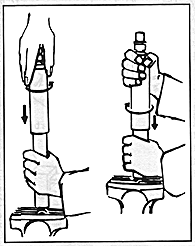 Remove the shock absorber from the vehicle and hold
it vertically with the lower eye or pin attached in a vise. Use clamp plates
to prevent damage.
Remove the shock absorber from the vehicle and hold
it vertically with the lower eye or pin attached in a vise. Use clamp plates
to prevent damage.
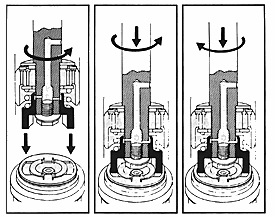 Fully
collapse the shock absorber, at the same time turning the dust cap
or piston rod slowly to the left (counterclockwise), until it is felt that
the cams of the adjustment nut engage in the recesses of the foot valve
assembly.
Fully
collapse the shock absorber, at the same time turning the dust cap
or piston rod slowly to the left (counterclockwise), until it is felt that
the cams of the adjustment nut engage in the recesses of the foot valve
assembly.
Some shock absorbers include a bump rubber concealed under
the dust cover and it must be removed prior to adjusting.
The damper may have already been adjusted. Therefore check
whether the shock absorber is in the adjustment position or not by keeping
it collapsed and gently turning it further to the left counting at the
same time the half turns until a stop is felt. Stop turning then and do
not use force.
Keeping the shock absorber collapsed, make 1 half turn
(180 degrees) to the right (clockwise). In case of prior adjustment add
the number of half the turns previously found. The total range is about
5 half turns.
Pull the shock absorber out vertically without turning
for at least 1 cm to disengage the adjusting mechanism. The dust cap or
piston rod may now be turned freely.
IMPORTANT WATCHPOINT: Oil
shocks provide much better comfort while gas shocks offer better road
holding, cornering and braking. There are no good or bad shock
absorbers, there are only shock absorbers that can be happier for your
driving style. SEE VIDEO.
This
striking difference is more true of the vintage Morgan suspension
(until 2019 when the original Morgan design was abandooned by the
Company). In short, if you want to have a mellow more compliant ride, subject to your rear leaf spring rate, use oil charged shocks and if you wish a hard racer's (which I have never been able to fathom why) use gas-charged shocks.
|
SPAX (see the important note on gas charged shocks/dampers)
RECOMMENDED SETTING REAR = SOFTEST Do not change this.
If you do, buy other shocks. Even at their softest setting I found them too stiff. I did, however, use them for 2 years before trying Rutherford AVOs. We were both stunned at the Rutherford AVOs
RECOMMENDED SETTING FRONT = Whatever you think gives
you the least feedback at the setting wheel.
Spax has gone through a number of hands..and a few insolvencies.
Servicing is nowhere near that of Konis when I had them.. On the other hand, their gas shock series
are the top of their line and gas is great shock technology, so we are
comparing the top of one line to the mid-range in the other.
The adjustment for Spax (14 rear and 5 front) is simply
a turn of a screw on the shock body and a feel for the clicks (or simply
go to the end and count turns to the other 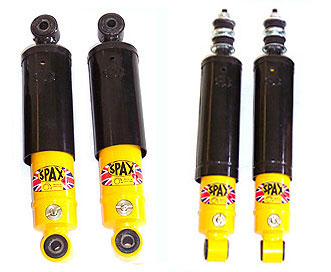 end
and adjust accordingly.) The screw adjusts rebound as well...so much for
"firming it for luggage". (I used to do that years ago before each trip
and then found myself adjust right back to where I started on the first
day's drive showing me my backside was a better judge than my brains).
Sadly. the adjustment at the rears is made difficult by the MMC setup as
the adjustment knob faces away from easy access.
end
and adjust accordingly.) The screw adjusts rebound as well...so much for
"firming it for luggage". (I used to do that years ago before each trip
and then found myself adjust right back to where I started on the first
day's drive showing me my backside was a better judge than my brains).
Sadly. the adjustment at the rears is made difficult by the MMC setup as
the adjustment knob faces away from easy access.
There was a comment that too many adjustments on Spax
was unnecessarily confusing. It isn't..but more importantly when the shock
begins to go you have 14 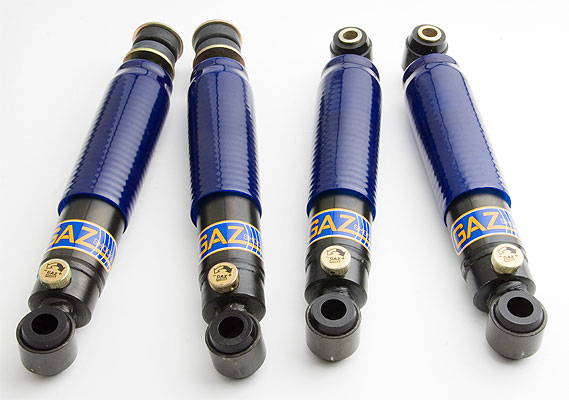 adjustments to keep the shock at that rebound rate
you like. Might give you another 10,000 miles on a fading shocks
without a sacrifice of any ride quality. In that case, you are adjusting
the shock to keep it the SAME firmness.
adjustments to keep the shock at that rebound rate
you like. Might give you another 10,000 miles on a fading shocks
without a sacrifice of any ride quality. In that case, you are adjusting
the shock to keep it the SAME firmness.
Spax adjustment is suposedly NOT destroyed by bottoming or topping
out. The ideal setting in the rear for Morgans is the most soft to two
from the most soft. In front, it is the softest or the one next to it.
It is relatively easy to adjust Spax yourself. Find a
stretch of familiar road with familiar bumps and that will be your laboratory.
Go up and down and adjust the rear shocks (first) until you go over a bump
and react with 1.5 bounces (1.5 bounces is the ticket for any shock and
normal driving). Then put on the front Spax and set them to softest and
see how it feels, then try one up and do the same..then choose the better
one and so on. Koni is even easier..for road driving always the softest both ends.
Sounds sensible to me and Koni swears by it. N.B. Spax, even at their softest
setting, is firmer than Koni and Rutherford AVOs at the rear.
GAZ
SHOCKS (see the important note on gas charged shocks/dampers)
RECOMMENDED SETTING REAR = SOFTEST Do not change this.
If you do, buy other shocks.
RECOMMENDED SETTING FRONT = Whatever you think gives
you the least feedback at the setting wheel.
GAZ shocks were offered by the Morgan Motor Company as a "suspension upgrade".
They have a similar appearance and adjustment method as the AVO
shocks now the NEW ELMS. I have tried them on all models up to 2013. Those who have purchased or tried them
declare that they are an improvement over the MMC standard shocks but not
as good as any of three options cited above. After trying them, I agree. They
are up there at the SPAX
level
but cheaper and as easy to adjust as the AVOs.
BILSTEIN SHOCKS
Finally
got around to trying them this summer (2024) ..for less than a
day. They are good company with a fine reputation but these shocks have
not as good as the made-for-Morgan choices for trad Morgans IMHO. I sensed it and then
researched it. The
Bilsteins only control bounce but not rebound, so in effect, they
work like an additional spring imparting an unwanted stiffness that other choices do not.
HOW LONG DO DAMPERS (AKA SHOCKS) LAST?
by gomog (aka Lorne)
It
is a common illusion that shocks last forever. They definitely do
not...and gas charged shocks (the good ones) last less than hydraulic
shocks. A "normal" vehicle, with much more than a Morgan trad's
rudimentary suspension (that I adore) shocks can last 50,000 miles and even more,
but their effect begins to deteriorate earlier than that minimum. And
shocks on Morgan trads never last as long as other cars. David
Rutherford, who created his marvelous and bespoke Rutherford AVOs, (other AVOs for Morgan should not be purchased)
and which I have loved since swapping them in for new SPAX, told
me they would last 20,000 miles. I found they were still the
same after 30,000 miles but I almost never use my car in urban driving and I leave my Morgans on stands when not being used. Yes. dampers and tyres are sadly effected as long as the wheels on on the ground.
| WATCHPOINT: I
prefer gas dampers shocks because their effect does not change
with usage. Shocks hydraulic liquid heats as they are used, more so
when one drives robustly. The liquid in hydraulically-charged dampens
less...something I learned from competition snowmobiling..before I
swtiched THEM to the more expansive gas-charged shocks. |
THE CORE OF THE DYING DAMPERS PROBLEM
Morgan trads rely on their owners much more than any other cars.
In this, they hark back to the Golden Age of Automobiling. Modern cars
are made and designed to eliminate that reliance, much
like player pianos that have no need of an accomplished
musician to play them perfectly. Trads are at their best when they have
a seamless synergy with their driver/caretaker. That is why they so
please our instincts. For better or worse, trads put the driver/owners
in control and in doing so we have more fun.
The major problem with trads dampers, as
it with other areas and parts of automobile, is that component
deterioration is incremental. Most people do not notice that their
brakes need new pads, shoes need replacing or re-compounding, and the fluid needs refreshening.
In the damper area, most have no idea that their shocks have seen
better days and are not doing their job as they originally did. That
requires a sensitivity and feel memory that few of us have! And even
when I felt something was amiss,the first time, I looked to the wrong
areas.
| Even I have been a victim of incremental wear and this despite my much higher than normal Morgan
mileage and a full mechanical relationship with my Morgans, which made
more sensitive to anomalies than others. Before I first noticed my
dampers (MONROE, SPAX and AVOs) needed replacement, I found myself fiddling with tyre air pressure and tyre types (tyres are the primary suspension component on all trads.)
and/or the adjustment valve on the shocks, assuming they are
adjustable. I finally realized that these dampers had all
deteriorated to the point where suspension dampening was prejudiced.
(duh!) Replacing them, even like for like, cured the issue. With
the AVOs, this was at 30k miles. I am happy I did not prejudice more of
my mogging. Now I KNOW when when my shocks are due. |
Of
course, one can merely replace one's Morgan trad dampers at 20,000
miles as dear David R. suggested. But who does that? The thingies
always look the same, and this stuff only slowly creeps up on you. We
could test them I suppose...read on.
HOW DOES ONE TEST A SHOCK/DAMPER??
99% of the tests the internet suggests do not work. And if the shocks are visible broken or leaking you should be shot. :( Many
of us are so immune to car feel that we wait until our shock
brackets sheer from the consequent impacts as shot shocks leave them
vulnerable. Others wait until their leaf springs sag,changing
the key suspension arena travel we need for our trads and the
dynamics of the damper travel. They even use adjustable suspension
stops to compensate for an ever abherrant suspension
travel....analogous to putting a bandaid on a broken arm.
And the infamous bounce test presumes any human can remember a
precise dampening rate from one car to another, or the change in
the amount of damper bounce years and miles after it being new. An
honest mechanic will admit all that is for show. (wry smile) One needs
specialized machines to ascertain dampening rates precisely. Only shock
makers have them..not any garage I know of, Morgan or otherwise.
But compromises are possible.
I am lucky. I like trying things
and unlike most, I remove anything, regardless of purchase price, that
does not noticeably improve the car. I then leave such stuff in stores
or give it away...most to my daughter's boyfriends I didn't like.
So I have new made-for-Morgan shocks at hand. They might not have the
original dampening rates of what I have on the Morgans, but they are
close. (I check dampening rates before I buy any shocks). I remove a
suspect shock and test them against a new one. WOW! Can one THEN see
the difference usage can make!!!!!!!!!!
Few
of us will have new Morgan shocks at hand. But a Morgan dealer does!
The test takes minutes. Ignore the his bounce test. HAve him/her remove
a shocks, bring out a new one, and both of you compare. This is, after all, your hobby.