REAR WHEEL BEARINGS - SALISBURY
Lorne Goldman at the eMog
Pub
It was I who had the recent problem with the removal
of the hub from the rear axle in order to get to a suspect seal. Sorry
to report no further progress. Phil
This rear bearing replacement is an evil job.
It is wise to understand the general layout of the task
and I have provided a small section of a similar (not identical) configuration
as a reference point. It is always wiser to understand what is happening.
 One
must also consider all risks at all stages and take the greatest of care.
Where will the impacts be going...(every action has a reaction!), where
are your fingers, what parts can be damaged (aside from
One
must also consider all risks at all stages and take the greatest of care.
Where will the impacts be going...(every action has a reaction!), where
are your fingers, what parts can be damaged (aside from
yourself)...etc etc. At the moment, the only fully
functioning spare Plus 8 Salisbury 7HA I know of on the planet, is my old
one. (sad smile)
You will need a new Timkin bearing (or 2 for both sides)
and two oils seals per side....an inner one and the outer one.
To access the wheel bearing (41) one must remove the axle
shaft (45). To remove the axle shaft you must be able to exert some force
on it as it will be pretty tightly on.
You remove the drum, the brake shoes, brake cylinder and
bolts from the backing plate as these bolts hold the bearing cap. You need
the driving plate (hub), as this is will be the base to attach your pulling
device or accept the blows necessary to remove the assembly.
Now go rent a slide hammer....a large one with a heavy
weight. This is a cute tool with a long round shaft on which a hammer weight
slides. The impact produced by quickly moving the weight towards the end
of the shaft is used for pulling out the driving flange, the half shaft,
etc.. You will need a slide hammer that can be used with the driving flange
you have...often these can be rented with different fittings. After many
whacks and much patience, the whole assembly should detach from the differential
and there will be your bearing..likely still attached to the shaft. Not
to worry, the fun may be just beginning! PLEASE note
where everything goes and its alignment. You must be
very careful as there are four shims there that require careful placement
to eliminate end play.
It may also be possible to remove the assembly if you
can whack the hub from the rear ...(ugh)
Properly functioning bearings decrease friction and therefore
reduce heat. Improperly functioning bearings will not do so and the heat
therefore produced can actually weld the bearing to the shaft. Sometimes
this can be removed with careful whacks and sometimes
you can cut mostly through the bearing (DO NOT TOUCH THE SHAFT!) and then
remove the weakened remainder. No diagnosis or prognosis can be made until
you are there.
You must also ask yourselves why this happened. Most will
never have to change their rear bearings. The bearing could have been defective
(unlikely), the installation was improperly done, the seals failed or
the axle was not greased...the greasing actually packs
the bearing with grease.
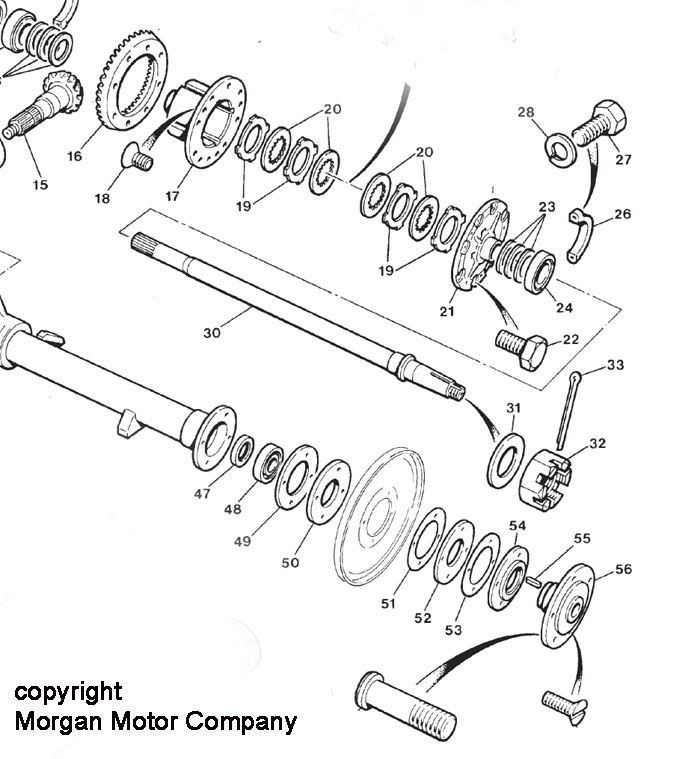
Axle Shims -3HA Salisbury
Gerry Willburn at the eMog
Pub
The 3HA Salisbury axle in your 1955 Plus 4 is a semi-floating
type. The shims are, as you guessed, to control the end play of the
axle. This should be between 0.001 to 0.005 inches (0.025 to 0.125 mm).
The bearings are NOT pre-loaded.
You have to re-assemble the axle with the shims in order
to measure the end play. You also want approximately the same thickness
of shims on both sides of the axle.
Assuming that it was nearly correct to begin with, re-assemble
the axle with as close to the same thickness of shims on both ends as you
can. Using a piece of hardwood to protect the threads on the axle ends,
bash on the end of the axle from both sides of the car to seat the shims
and outer bearings.
Mount a dial indicator to the backing plate and measure
the end play of the axle as pressure is asserted on both ends, Then
adjust shims as required to achieve the required 0.001 to 0.005 inch
play.
It sounds harder than it is. Gerry
Additional comment as to WHY they are needed:
by Mike Miles
The cumulative tolerance of the axle shaft lengths and
the thrust button shaft in the diff with respect to the total length of
the axle housing needs to be accounted for.
Also, during use, the end faces of the thrust button
shaft and the ends of the two axle shaft wear against each other so the
axle end-play increases. Eventually the thrust button would have to be
replaced.
WHEEL BEARINGS 7HA SALISBURY CARS
by Norm Patterson at the eMog
Pub March 9, 2011
7HA Phase 2 Salisbury
Front Pinion:
M86610 front race
M86643 front bearing
Rear Pinion:
HM88610 rear race
HM88649 rear bearing
Axle Bearings:
LM501311 race
LM501349 bearing
WHEEL BEARINGS FOR BTR CARS
Front Bearings:
TIMKEN 67048/67010
TIMKEN 11949/11910
Rear Bearing:
?