Morgan/Rover Head Casting Numbers and Types
| Pre 1976 There are probably not many pre-SD1 heads in circulation now.
Apart from having more restrictive ports they also had smaller valves like the Buick 215. Standard pre-SD1 valves are 38mm inlet and 33mm exhaust. |
| ERC 0216 1976-87
SD1 production for twin SUs (carbs in general), all V8s from the
introduction of the SD1 took on the new specification cylinder heads.
They incorporated larger inlet & exhaust valves as well as revised
combustion chambers (36cc), taking a 19mm reach spark plug. Anything
with a V8 made between the noted dates should have this spec. The SD1 also
introduced inlet valve umbrella oil seals, simply a nitryl washer which
is pushed over the valve stem before fitting the spring and retainer.
These seals often breakdown under the severe environment inside the
engine and disappear altogether! |
| ERC 0216 Vitesse On introducing fuel injection a small cutout was ground in each inlet
port to clear the injectors, with the special Vitesse, the
heads also incorporated flowed valves; with a 30° back cut and wasted
stems on the inlet valves, very different from the standard SD1 type.
As the SD1 was phased out of production, the Range Rover was just going
over to Efi, thus all V8s after this date feature virtual vitesse spec
Efi cylinder heads, including the first 3.9s. |
| HRC 2210 Early 90's.
Here comes the confusing time period. It seems sure that all V8s now
had vitesse valves, as after 1993 Efi became standard. In 1993 or just
before, the valve guides changed to the modern cap type (blue), one for
each valve, all V8s took on this feature yet the casting remained as per
the Vitesse. 4.2 Litre motors however also had factory standard vitesse
heads, but during production Rover switched to composite gaskets, whilst
retaining vitesse heads. The heads were machined to bring back the
required compression, the same thing happened to the then current 3.9;
you may also see some 4.2s with only 10 head bolts, the outer 4 holes
through the head being plugged, these are the composite gasket units.
|
| HRC 2479 1994
Tempest and Thor With the introduction of the new Range Rover a new head was
brought into being, with a revised casting the head had larger
ports than the vitesse heads but retained the same valves and guides
which were present from 1993 onwards. The combustion chamber volume
(29cc) was also reduced (by simply machining off more material on the
face) to compensate for the increased thickness of the composite head
gaskets and probably most noticeable, the 14 head bolts were reduced to
10, the 4 outermost being removed. Incase you're told otherwise, 4.0
and 4.6 litre heads are identical. |
| WILDCAT HEADS There are aftermarket heads..the most popular being Wildcat heads from Wildcat Engineering in the UK These
are a completely new casting with much larger, higher ports that have a straighter path to
the cylinder. These heads can be fitted with 49mm inlets and 41mm exhausts. Power outputs
of 400-450HP are easily achievable with these if the rest of the engine is built correctly. |
| OTHER HEADS On
a periodic basis other performance heads appear. They are invariably
expensive and often have casting anomalies. Be very careful. |
Plus 8 Timing Covers
The Plus 8 V8 has been under
our bonnets for so may years it is not surprising that many components
have undergone changes, the timing cover or 'front cover' is one of the
most noticeable. Please excuse the dates below as each change had a transition period.
Buick 215
These covers are similar to the pre-1976 covers (see below) except
their oil pump casing points in an unusable direction for a
Morgan.
Pre 1976
The cover uses rope oil seals around the front pulley and a short oil pump
casing, the water pump is situated above and between the block water inlet
passages, with the distributor held down with a clamp and separate bolt. (N.B. Range Rover. From
it's introduction in 1970 this vehicle had a redesigned cover, the only
differences from the saloon cover being the positioning of the larger water
pump, above and to the left of the block water ways and an oil seal protector
plate.)
Additionally both
of the covers gained deeper oil pump casings allowing for greater flow,
metric oil filter threads and rubber lip seals for the pulley.
Sd1 1976-1986 both
of the covers gained deeper oil pump casings allowing for greater flow,
metric oil filter threads and rubber lip seals for the pulley.
1987
The SD1 ceased production and with it died the original saloon timing cover,
from this date all covers were those designed for 4x4 vehicles.
1990-1993
The cover gained studs to hold in the distributor rather than a separate
bolt.
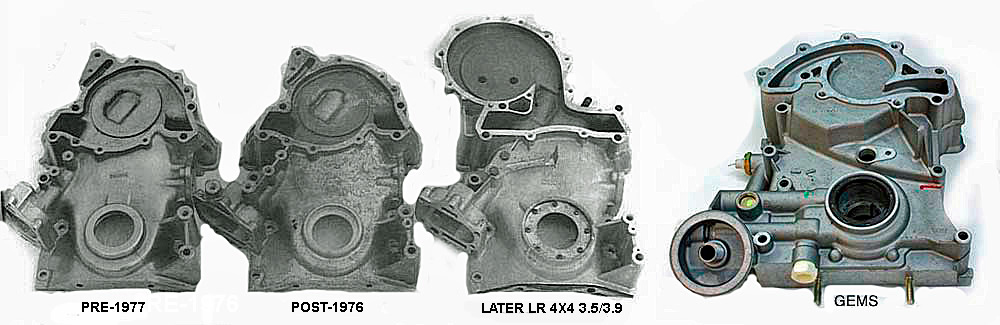 1993
A new cover was introduced for the 3.9 (and the non-Morgan 4.2) late model
engines with long cranks, this is shown at the top of the page and was
the best cover to date, using a rotor oil pump of greater capacity than
the old type and using a new water pump design with a counter rotating
impellor. However it is not easy to fit to an older 3.5 as the crank
nose was lengthened in order to accommodate the oil pump and pulley, 3.5
cranks aren't long enough. Although the oil filter attaches and points
in the same direction as the older cover, there is no separate oil pump
base as obviously is is not required.
1993
A new cover was introduced for the 3.9 (and the non-Morgan 4.2) late model
engines with long cranks, this is shown at the top of the page and was
the best cover to date, using a rotor oil pump of greater capacity than
the old type and using a new water pump design with a counter rotating
impellor. However it is not easy to fit to an older 3.5 as the crank
nose was lengthened in order to accommodate the oil pump and pulley, 3.5
cranks aren't long enough. Although the oil filter attaches and points
in the same direction as the older cover, there is no separate oil pump
base as obviously is is not required.
1994 - 1999 A
new cover was introduced which was much thinner than it's forbearers,
having no hole for a distributor the cover is very compact, having the
oil filter fitting pointing directly downwards. The oil pump is
driven by the crankshaft rather than the camshaft and is fully
incorporated into the cover, making an oil pump replacement incredibly
expensive and tedious. However, it increases oil pressure. It is
unsuitable
for any V8 owner who wishes to run a distributor.
| WATCHPOINT
These later distributerless covers can be replaced if you are lucky
enough to find a "INTERIM COVER". These are made to fit with all
engines are are driven off the crankshaft as well. However, they are
made to run with a distributor. |
| WATCHPOINT 2 May 12, 2018 I have noticed that J.E. Developements,
a respected supplier, is now offering these dual purposes covers at 1/2
the price than Land Rover was last selling its single pupose Gems
covers. |
1999 - 2004
Identical except for an extra sender unit boss mounted above the oil filter
housing. For replacement, read above.
N.B. It may be an idea to pick up a spare timing
cover if you have a pre-1988.
Replacing Valve Seals or Valve
Springs (with the heads on)
Valve stem seals can be replaced with the heads in place
in the car. Bend up a 450mm piece of 10mm rod into a sharp vee, 50mm from
one end. Then bend the rod at right angles next to the vee to form a handle.
The rod can be used to depress the valve spring by hooking
the point of the vee over a rocker stud with a nut on it. To hold up
the valve, turn an old spark plug into an air connector and use a compressor,
or feed about one metre of small rope into the cylinder and jam it up with
the piston.
BACK