BRAKE
LIGHT SWITCH (a saga)
BRAKE
LIGHT SWITCH (a saga)
by Lorne Goldman at the eMog Pub 2011
1. Recent Developments
2. Replacements
3. Wiring in a relay
RECENT DEVELOPMENTS
If you are reading this, it is likely your Morgan brake
light switch failed..maybe a few times already. Not to worry, you are now
member of a large club! Just in case, you can test by removing the wires
from the brake light switch and "jumping" it with a wire in between. If
your brake lights go on, the switch is defective.
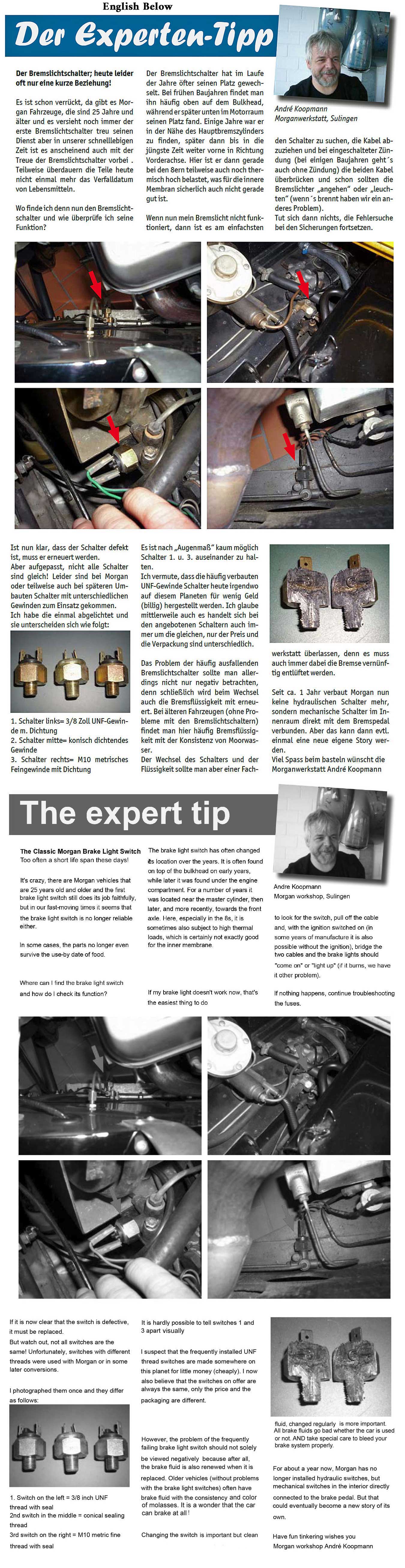
For some reason. the hydraulic brake light switches seem
to fail regularly in the last few years (# SPB 401..seems to be a Lucas)
so much so that the Factory has moved to a mechanical switch. Image on
the right.
Sadly, the Factory mechanical switch option is very costly
and invasive. As it is mounted in front of the pedal, it cuts into the
precious footwell space..especially for those of us with longer legs. So
use one of the many replacements and carry a spare.
REPACEMENT OF THE EXISTING SWITCH (A BIG WATCHPOINT!!!)
 These
switches are fitted in the car to a 4-way junction inside of the brake
side valence (inner wing)..either forward next to the pertinent front wheel
(post 1993 cars) or close to the Master Cylinder. The way the factory fit
the 4 way junction is key to the installation.
These
switches are fitted in the car to a 4-way junction inside of the brake
side valence (inner wing)..either forward next to the pertinent front wheel
(post 1993 cars) or close to the Master Cylinder. The way the factory fit
the 4 way junction is key to the installation.
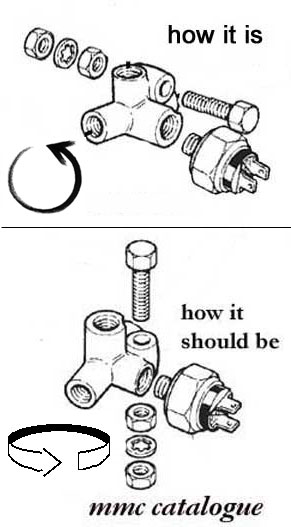
The 4 way junction has a single fitting screw. In the
Morgan parts book, the junction is shown with the fitting held to the frame
flange below. This is correct. It prevents the junction rotating as you
unthread or thread the brake light switch, preventing the metal brake lines
from being turned with the junction. (OUCH!) Sadly, many of these
junctions were installed by the Factory with the fitting screw through
the valence rather than the frame flange. See where your junction fitting
screw is before you remove the switch. Look at the pictures.
If it is fitted through the valence, BE CAREFUL. You have
three options. You can remove the brake lines and switch, drill and refasten
the junction through the frame flange, refit the lines and switch to the
newly oriented holes (they all have the same thread) and bleed the brakes.
Alternatively, you can hold the junction with big vice-grips or a pipe
wrench to stop it from turning with the switch.
I have learned to use a socket and a very quick "slap"
to loosen the switch enough so it does not turn the junction. A slow steady
force WILL turn the junction when the switch is tight. See the diagrams.
REPLACEMENTS POST-1975
switches
Though a perfect and inexpensive mechanical switch would
be an ideal solution, until one is sourced, we need an immediate easy solution.
(Often these turn out to be permanent anyway!). The first thing is to avoid
the Factory original, the SPB 401. Along with being dear, (£14 in
the UK) and triple that from aftermarket suppliers in North America., they
often last only a short time. The original switch is a 3/8" UNF.
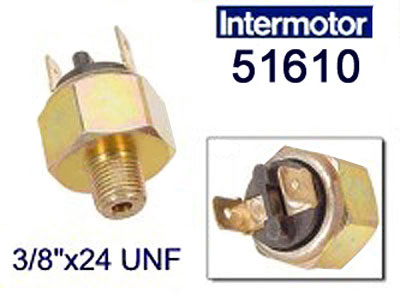
There is a popular replacement in the UK, an Intermotor
part which CAN last a bit longer. The Intermotor part number for
the post 1975 cars is 51610. (I have been told the Facet is 71099 and Webcon
is WBL087 but unconfirmed as yet. The same switches were used on
the Lotus Elan 61-75, Europa 69-76, Seven Twin
Cam 1972, Super Seven 63-72, Reliant Rebel
69-74, Rover 2000 & 2200 63-77, and the 3500
from 68-72. The Singer Chamois 64-71. Gazelle 61-71.
Humber Hawk 62-68. Super Snipe 64-66. Imperial 64-68. Sceptre 63-76.
Hillman Hunter 66-79. Husky 62-72. Imp 63-76. Minx
61-71. Talbot Sunbeam 69-76. Singer Vogue 61-71.
This will help the owners in the UK, but not elsewhere.
In North America, I have found a replacement for the post
75 switch that has lasted longer than anything I have tried before. It
is Welles RB 401. It is not EXACTLY the right thread, but I took the precaution
of buying a spare brake junction and its threads in with a little effort
and then both the originals, the Intermotor and the Welles can all fit
in the same socket without an issue or leaking. Frankly, the Welles switch
fits better than the original. It is available everywhere. I got mine discounted
from World Discount, (716 877 2458) in Buffalo NY. The contact is NEIL
and he will now sell and post anyone who calls. At $3.45 (£1.90)
each, buy more than one and carry an extra with you! (You should do that
with any brake light switch you buy.)
 HYDRAULIC SWITCHES THAT ARE COMPATIBLE
Earlier switches last much longer than the MMC supplied
ones.
For the pre-1975 cars, the earlier switch (Lucas SPB 400
and 1/8" x 27NPTF) corresponds to a Intermotor 56100.) The original was
also used on the Alfa 1750 from 68-72, the 2600 in 62-68, the Giula 62-71.
The Fiat 500 from 55-75, 600 in 56-68, the 1100 54-68, 1200
66-70. The Ford Anglia 59-68, Capri, Classic 61-64. Corsair
1500 GT 63-66. Corsair V4 66-70. Cortina 1, 11 62-70. Escort
1 1/3 GT 68-71. Zephyr 4, 6 62-72,
Zodiac 62-72. In the Jaguar 2.4, 3.4. 3.8 from 63-69,
E Type 1-72, Mk 10 62-70, Sovereign 2.8 4.2 66-70,
XJ6 2.8, 4.2 68-71. Lotus Cortina 1, 11
63-70. MG 1100 1300 63-71. MGA 58-62. MBB GT 63-74.
MGC GT 68-74. Magnette 67-68, Midget 61-74, Reliant Regal 63-74,
Riley Elf 62-70, Kestrel 1100 69-70. Austin 1100 1300 62-74,
1800 65-67, A40 61-68, A60 67-69. Mini-Cooper
58-69. Morris Minor 62-71. Oxford 67-71. Seat 600
D, E, L, 63-73. Triumph Spitfire 63-67. TR4, A
62-67. Vanden Plas Princess 64-74. 127 71-83, 128
69-89, 1300, 1500, 66-70. Volvo 121, 122, 131, 221 from 61-68.
and the 1225, 123, 222 from 61-70. The Wolseley 1100, 1300
66-71, 16/60 69-70 and the Hornet from 61-69.
WIRING IN A RELAY
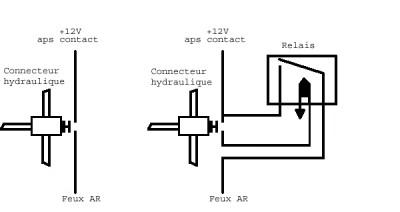
Our Morgan brethren in France, (found on the excellent
Le Bar des Morgans) have an idea that is less invasive than
many other solutions. Each time you press your brake pedal, the switch
is impacted with 3.5 amps current (with 2 stop lights) or 5.2 amps (when
you have a 3rd stop light). Reduce that opening current impact and you
will extend the life of the switch. This can be done by adding a relay
in the circuit. It reduces the impact on the switch to a few milli-amps.
The lifetime of contacts is extended accordingly.
Koopman