BRAKE FLUIDS
(updated March 2017)
by Lorne Goldman
Automotive braking is, as
we all know, an important factor in performance car building. The forward
thinkers pay an equal amount of attention to stopping as they do to making
their vehicles go fast. But here's a fact that not too many realize: when
you step on the brakes, you command a stopping force that's 10 times as
powerful as the force that puts the car in motion. Hard to believe isn't
it? No wonder the performance brake market has been vying for and finally
receiving our attention. But now that they've educated us in the importance
of quality components, it's now time to pay attention to the fluid that
activates and allows these components to work.
It only makes sense that
after you've spent big bucks and a lot of time upgrading your vehicle,
the completion of your job must go beyond adding just any old fluid into
the system. It's extremely important to always use a high quality fluid.
Let's face it, that quart of Elmo's Wonder Brake Fluid and Windshield Washer
Solvent combo you picked up at the swap meet may end up as the only thing
between the ball of your foot and a brick wall. So, let's at least pay
a fraction of the attention spent on choosing components on choosing brake
fluid. The following information should help you better understand the
differences between various types of fluids.
FLUID REQUIREMENTS
Brake fluid must function
through heat, cold, and all the variations of temperatures affecting all
brake systems. In other words, brake fluid must be and must remain viscous
(fluid) and resistant to severe conditions. It must also absorb water without
having an affinity for doing so. Brake fluid must be pure and contain no
contaminants, which will have a 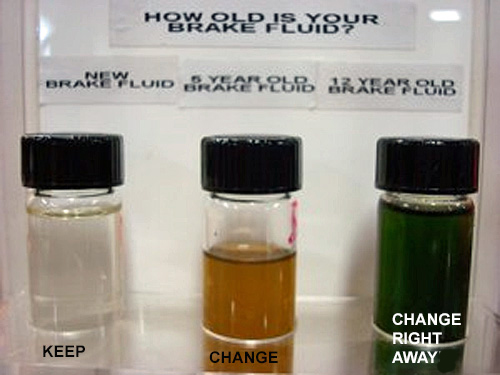 harmful effect on rubber components. It
also should serve as a lubricant for the moving parts in a brake system
and be able to withstand time and service....in other words, its boiling
point and chemical properties must remain stable. One more important factor
is that brake fluid should not cause an electrolytic action that will decompose
or degrade metal brake parts.
harmful effect on rubber components. It
also should serve as a lubricant for the moving parts in a brake system
and be able to withstand time and service....in other words, its boiling
point and chemical properties must remain stable. One more important factor
is that brake fluid should not cause an electrolytic action that will decompose
or degrade metal brake parts.
FLUID AGE
The
effectiveness of brake fluid changes over time, The amount of time
is a function of the average humidity level of the environment where
you keep your car (and fluid). I change mine every two years after testing with brake fluid quality tester..and
inexpensive and easily used affair you can find in very auto store or
Amazon. The less precise way is to look at the brake fluid in the
reservoir.If it is anything but crystal clear, it should be flushed and changed.
FLUID CLASSIFICATIONS
These factors are taken into
consideration by the Department of Transportation, National Highway Safety
Administration in Federal Motor Vehicle Safety Standard 116. FMVSS116-classified
fluids fall into four categories: DOT 3, DOT 4, and DOT 5 and now DOT 5.1.
DOT 3 meets their MINIMUM specifications and was used in 90% of US made
vehicles in 2007. DOT 4, 5 and DOT 5.1 meet more stringent requirements.
The purpose of these requirements is "to reduce failures in the hydraulic
brake systems of motor vehicles which may occur because of the manufacture
or use of improper or contaminated brake fluid." In addition to setting
the minimum wet and dry boiling points for all brake fluids, Federal Standard
116 deals with fluid viscosity, temperature and chemical stability, corrosiveness,
water tolerance, compatibility (between formulations), and effects on brake
system components.
WHAT'S THE DIFFERENCE?
It seems logical that if
DOT 3 is good enough then DOT 4 must be better. And, if DOT 4 is better,
then DOT 5 and DOT 5.1 must be better still. That is true saving a single codicil about DOT 5. I avoid it like the plague.
1.
The key is the boiling point and the absorption (or
not) of water. When brake fluid begins to boil (from
the heat that's generated in the system during braking or too close exhaust pipes) it forms gas
bubbles.
As these bubbles collect and grow, they form pockets of gas in the
system.
And since gas is much easier to compress than fluid, these pockets
cause
the pedal to easily compress or go soft. This is what as known as a
spongy
pedal--a condition that causes the heart to race.
2. The other factor is
whether the fluid absorbs water. Moisture always enters the system over
time. Non-silicone fluids absorb it, lowering their boiling point.
Silicone fluids do not, creating a siutation of two fluids (brake fluid
and water) in the system which creates the condition for foaming, mushy
brake pedals and rust within the system.
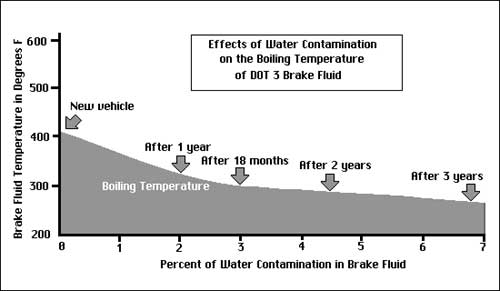
BOILING POINTS
The following chart shows
the aforementioned FMVSS116 minimum boiling points. These boiling points
are the biggest difference in the fluid classifications. You'll notice
there are two points for each classification of fluid. The dry boiling
point is for fresh fluid that has not yet absorbed moisture. The wet boiling
point is for fluid that has been in use (or in an opened container) long
enough for it to absorb moisture from the atmosphere.
WATCHPOINT Brake fluids must not be allowed to boil for two reasons:
1.) The brakes won't work due to the vapor bubbles being compressible.
2.) Physical and chemical properties of the brake fluid may change due to the "lighter" components boiling off. |
The different DOT spec fluids
have chemical or formulation differences, as well as boiling point differences.
There are (at this point) four mainstream commercial formulations for brake fluids;
three are glycol-based and the fourth (DOT 5) is silicone-based. DOT 3 brake fluids
are a mixture of polyalkylene glycol ether and other glycols (all start
life as ethylene glycol--antifreeze); DOT 4 and DOT 5.1 fluids add borate
esters to raise the boiling point.
IGH QUALITY NON-SILICONE FLUIDS
Castrol GT LMA
This is one of the LMA brake
fluids. LMA stands for "low moisture activity" and it fulfills this feature
well. It has the same boiling points as DOT 4. It is DOT 3 and DOT 4 compatible.
DOT 5.1 (not
to be confused with DOT 5!)
DOT 5.1 is another polyalkylene
glycol ether and borate ester combination. However, in this case, the mixture
can sustain even higher heats than DOT 5 without a mushy feeling. It is
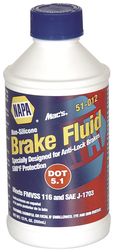
also compatible with DOT 3 and DOT 4 brake fluids. It can be bought at
NAPA under Part #51032 for 32ozs and Part #51012 for 12ozs.
| FLUID TYPE |
DRY BOILING POINT |
WET BOILING POINT |
| DOT 3 |
205°C (401°F) |
140°C (284°F) |
| DOT 4 |
230°C (446°F) |
155°C (311°F) |
| Castrol GT LMA |
230°C (446°F) |
155°C (311°F) |
| DOT 5 (silicone) |
260°C (500°F) |
180°C (356°F) |
| DOT 5.1 |
270°C (518°F) |
191°C (375°F) |
There are other more effective
fluids, Ford Heavy Duty DOT 3, ATE Super Blue Racing, ATE TYP 200,
Motul Racing 600, Castrol SRF, Performance Friction, etc but the
price is not justified for a road car and they are much harder to find. I use DOT 5.1
|
DOT 5 SILICONE BASE
BRAKE FLUID (SBBF)
The U.S. DOT defines silicone
brake fluid as that which consists of no less than 70 percent of adiorgano
polysiloxane by weight. Silicone-based fluids are regarded as DOT 5 fluids.
They are highly compressible and can give the driver the feeling of a spongy
pedal. The higher the brake system temperature, the more the compressibility
of the fluid--increasing the feeling of a spongy pedal. Silicone-based
fluids are non-hydroscopic, meaning that they will not absorb or mix with
water. When water is present in the brake system, it will create a water/fluid/water/fluid
situation. Because water boils at approximately 212 degrees F, the ability
of the brake system to operate correctly decreases, and the steam created
from boiling water adds air to the system. It is important to remember
that water may be present in any brake system. Therefore, silicone brake
fluid lacks the ability to deal with moisture and will dramatically decrease
a brake systems performance. Silicone brake fluid has a number of strengths
and drawbacks.
DOT 5 Strengths:
1) It has a high boiling
point since it does not absorb water. Therefore, there's no so-called wet
boiling point.
2) Doesn't absorb moisture.
3) Doesn't remove paint.
4) The viscosity is more
stable over the extremes of temperature.
5) With the exception of
some formulations used in external boots, silicone brake fluid is compatible
with all standard brake components.
DOT 5 Drawbacks:
1) It's hard to pour without
entraining air bubbles--hence an application will generally have a softer,
spongier pedal feel.
2) It doesn't absorb water,
so any water already in the system accumulates in the lowest point of the
system and stays there, causing rust.
3) Glycol fluids begin to
compress near their boiling points, whereas silicone fluids begin to compress
at around 300-350 degrees Fahrenheit.
4) Additives in the fluid
can vaporize at comparatively moderate temperature, increasing the spongy
feel.
5) Silicone fluids expand
significantly when hot.
6) Silicone fluid is functionally
incompatible with systems that have held glycol-based fluids for any length
of time, requiring flushing and seal replacement (there are counter opinions
on this, which state that the modern silicone formulations are in fact
compatible with only a flushing, rather than a complete reseal). The actual
DOT specification requires chemical compatibility, so as far as that goes,
the two fluids won't cause reactions if used in the same system, but they
certainly won't mix, either.
7) It's pretty much incompatible
with anti-lock brakes because the silicone fluids tend to be more viscous,
which can cause problems with the timing of the pulses that are intended
to work with the thinner glycol-base fluid. This sometimes leads to damage
of the ABS valving. The rapid pulsing necessary to anti-lock functions
tend to cavitate the fluid, as the tiny bubbles collapse and coalesce into
larger ones, and then collapse and reform into smaller ones. This tends
to counteract the ABS effect and can diminish the actual effective braking.
This condition also heats the fluid and can lead to even more sponginess
and possible damage to the ABS controller. Thirdly, silicone brake fluid
tends to foam when expressed from a small orifice under pressure, reducing
its hydraulic effectiveness greatly.
8. Silicone brake fluid compresses more than the polyalkylene glycol ether fluids, making it unadvisable for racing.
9. It should be changed every 18 months or when indicated with your fluid tester.
SILICONE BRAKE FLUID CONCLUSION: Silicone
brake fluid has too many downsides to be recommended for most cars.
It'is incompatible, even dangerous mixture with regular brake fluids
which is a massive drawback as even switching from one to the other is
a
big no-no. Over time, it creates a brake system fluid division between
water and
itself and becomes compressible when the brakes are used agressively
However, because it does not quickly strip paint so it is a good
option for people who do not drive in a sporty fashion and lean towards
protecting paint rather than performance. In any event, if you have
switched from one of the many regular brake fluids, do not switch back
unless you are willing to thoroughly flush the brake system and/or
switch in new components.
|
|
Brake Fluid Primer
DOT 3
DOT 4
DOT 5
DOT 5.1
N.B. There are many racing
fluids available..bringing the price and the quality of DOT 3 and DOT 4
far beyond the standard fluids.
|
DOT 3
DOT 3 brake fluid is the
"conventional" brake fluid used in most vehicles.
Advantages:
It is inexpensive, and available
at most gas stations, department stores, and any auto parts store.
It is completely compatible
with DOT 4 and DOT 5.1.
Disadvantages:
It eats paint and skin (wash
it off ASAP).
It absorbs water very readily.
Accordingly, once a container of DOT 3 has been opened, it should not be
stored for periods much longer than a week before use.
It is NOT compatible
with Dot 5 whatsoever and should never be mixed. A safe switch from DOT
3/DOT 4/DOT 5.1 to DOT 5 requires a complete flush of the braking system
and a change of all seals in the hydraulic system.
Maintenance
Flush every 2 years.
|
|
DOT 4
Advantages:
It is available at most auto
parts stores, and gas stations and department stores.
It does not absorb water
as readily as DOT 3 fluid.
It has a higher boiling point
than DOT 3 fluid, making it more suitable for high performance applications
where the brake systems are expected to get hot.
It is completely compatible
with DOT 3 and DOT 5.1.
Disadvantages:
It eats paint and skin (wash
it off ASAP).
It is about 50% more expensive
than DOT 3 fluid. (One brand is the easily found Castrol LMA)
It is NOT compatible
with Dot 5 whatsoever and should never be mixed. A safe switch from DOT
3/DOT 4/DOT 5.1 to DOT 5 requires a complete flush of the braking system
and a change of all seals in the hydraulic system.
Maintenance
Flush every 2 years.
|
|
DOT 5
DOT 5 brake fluid is also
known as "silicone" brake fluid. It was designed for the US Army, who has
regularly requested permission from Congress to stop using it.
Advantages:
It does not eat paint or
skin.
It does not absorb water
(BUT!!! See more on this under disadvantages, below.)
It has a higher boiling point
than DOT 3 and DOT 4.
It is compatible with all
rubber formulations.
It is a good choice for Concours
cars which are rarely driven and/or never driven hard.
Disadvantages:
It does NOT mix with DOT3
or DOT 4 or DOT 5.1. Most reported problems with DOT 5 are probably due
to some degree of mixing with other fluid types. A residue of the
former non-compatible fluid is sufficient to cause serious issues. The
best way to convert to DOT 5 is to totally rebuild the hydraulic system.
Additionally, the same advice applies if switching from Dot 5 to any of
the other fluids.
Since
DOT 5 does not absorb water, any moisture in the hydraulic system will
"puddle" in one place. This can cause localized corrosion in the hydraulics.
Careful bleeding is required
to get all of the air out of the system. It is hard to you without introducing
bubbles and thus results in soft pedal feel. These small bubbles will form
large bubbles over time. It may be necessary to do a series of bleeds.
DOT 5 is less compressible
(often creating a slightly softer pedal). It is not recommended for racing
application.
It is hard to pour
without introducing bubbles and thus results in soft pedal feel,
It is not recommended by
the brake manufacturer, especially for ABS brakes.
It is about twice as expensive
as DOT 4 fluid.
So silicone fluid aerates
easily. Harley-Davison, one of the sole current OEM users of silicone fluid,
warns buyers to let the fluid sit at least an hour before using it. If
shaken on the way home, it will aerate enough to look like a freshly poured
soft drink. Silicone fluid is also slightly more compressible than glycol
fluid, does not change color to tip the user to its moisture content, and
worst of all, neither accepts or disperses moisture, making systems using
it more corrosion prone, and requiring much more frequent fluid changes.
Silicone brake fluid also lacks glycol fluid's naturally occurring lubricity,
making it incompatible with the mechanical valving in some anti-lock braking
systems.
|
|
DOT 5.1
 DOT5.1
is a relatively new brake fluid that is causing no end of confusion amongst
mechanics. The DOT could avoided a lot of confusion by giving this new
fluid a different designation. The 5.1 designation could lead one to believe
that it's a modification of silicone-based DOT 5 brake fluid. Calling it
4.1 or 6 might have been more appropriate since it's a glycol-based fluid
like the DOT 3 and 4 types, not silicone-based like DOT 5 fluid. DOT5.1
is a relatively new brake fluid that is causing no end of confusion amongst
mechanics. The DOT could avoided a lot of confusion by giving this new
fluid a different designation. The 5.1 designation could lead one to believe
that it's a modification of silicone-based DOT 5 brake fluid. Calling it
4.1 or 6 might have been more appropriate since it's a glycol-based fluid
like the DOT 3 and 4 types, not silicone-based like DOT 5 fluid.
As far as the basic
behavior of 5.1 fluids, they are much like "high performance" DOT 4 fluids.
Advantages:
It provides superior performance
over all the other brake fluids discussed here. It has a higher boiling
point, either dry or wet, than DOT 3 or 4 or even DOT 5. In fact, its dry
boiling point (about 275 degrees C) is almost as high as racing fluid (about
300 degrees C) and 5.1's wet boiling point (about 175 to 200 degrees C)
is naturally much higher than racing's (about 145 C).
It is compatible with all
rubber formulations.
It is completely compatible
with DOT 3 and DOT 4 making an upgrade from either easy..
Disadvantages:
It will absorb water.
It will eat paint.
It is more difficult
to find for sale, typically at very few auto parts stores. Try NAPA #NBF51012
It is mildly more expensive
than DOT3 or DOT4.
It is NOT compatible
with Dot 5 whatsoever and should NEVER be mixed. A safe switch from DOT
3/DOT 4/DOT 5.1 to DOT 5 or vice versa requires a complete flush of the braking system
and a change of all seals in the hydraulic system.
This is the fluid I use.
|
Testing to See WHICH Fluid You Have
The danger is whent you do not know what type of fluid you have in there
now. We must ascertain that first and foremost because mixing DOT 5 with anything else is very dangerous. That MUST be checked out first. DOT 5
is not compatible with all other brake fluids and deep sadness can
result by mixing, even trace elements, of one with the others.
1. Get a eye dropper and take some fluid from the reservoir.
2. Place it into a clean glass jar and add some clean water to the fluid.
3. Replace the lid and shake it well.
4. Let it stand for a few minutes.
5. If the water and the fluid have mixed thoroughly and cannot be
separately identified, then you have regular auto brake fluid. (DOT 3,
DOT4, DOT 5.1 or LMA or Castrol Brake Fluid DOT 4. They are
all compatible and you can top up with any of the others.
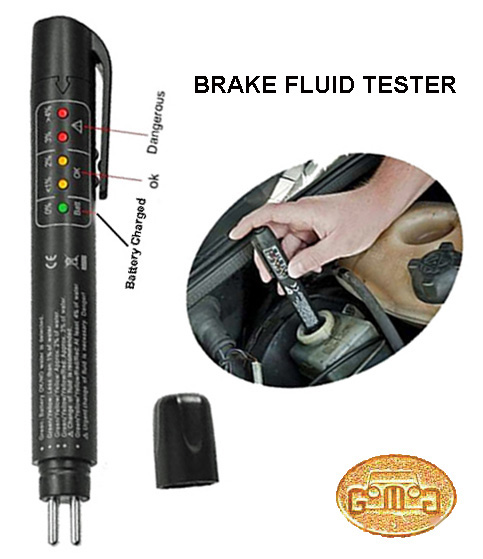
Testing2 Your Brake Fluid For When to Change It
Different
ambient environments and car usage affect the deterioration rates of
brake fluids. Some cars fluids will last longer than others and some
MUCH less. This can be avoided by mwerely buying a brake fluid tester.
These can be as simple as buyijng a pen-like tester and testing the
fluid in your brake fluid reservoir (s). They are available at your
local auto store. Halfords, Autozone..etc or ebay and Amazon.