| N.B. Salisbury (until 1995) and BTR axles (from 1996) are very different. Do NOT confuse them as they MUST also be treated differently. The BTR is a noticeably bulkier axle with two plugs, one at the rear and another (the drain) at the bottom. The Salisbury Plus8s axles have three square plugs (14mm). One at the top, one at the bottom and one at the rear. The 4/4s/ and Plus 4s have two plugs. If you have doubts on which you have, contact the webmaster. |
Later BTR are technically spec'ed to last 40000-80,000
miles without a fluid change (I change mine every 25,000 miles). The level
should be checked at every service however (every 3000-5000 miles). If
"chattering" noises occur, it is time to refresh your friction modifier. For
the lubricant, the only supplier they recommended
was Castrol SAF-XJ. Sadly, this lubricant was only easily sourced in
the
Downunder, UK and Europe but was not available in North America and
other Morgan countries. However, a similar BTR was used by BMW and it
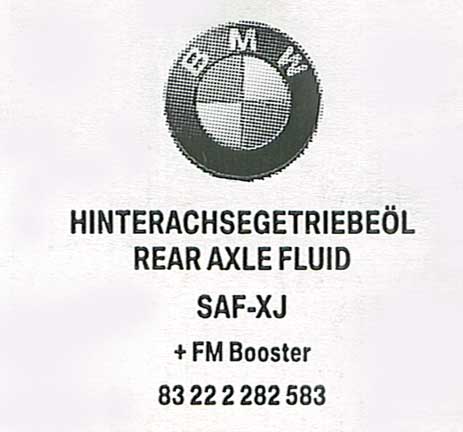
can be sourced under their part number 83 22 2 282 583 (see the label)
at any BMW dealer. This product already contains the necessary
"Friction
Modifier" (aka STURACO, an Italian made product that goes by many
names) so it is unnecessary to add anything. BMW is one of the few automobile manufacturers I trust. The
recommended fluid from BTR has been changed so often that and is so
uncertain from continent to continent that I left it to BMW.
The Morgan Motor Company also uses and recommends this
lubricant rather than using their normal supplier of lubricants, Morris.
We found that Morris, a very reputable but tiny local firm, often has dated ideas of what should
be used in Morgan axles and gearboxes. (wryly) They will also not give out a comprehensive
fluids' constituent list so there is no way of checking what is or isn't
in them. Considering the incidence of chattering BTRs filled at the Factory
(cured by the simple addition of 2-3 ounces of FM) and R380s gearboxes
filled with ATF (unwise).
FLUIDS FOR LSD BTRS
Take the car (if possible) on a short run to warm the lubricant a bit.
 1.
Place the car on a level surface.
1.
Place the car on a level surface.
2. Jack up the rear and remove the level plug.
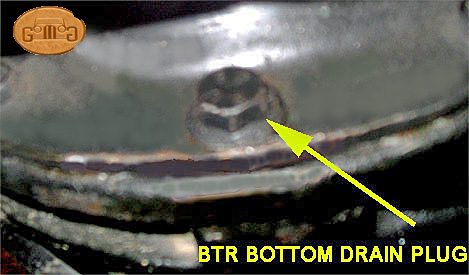
[A BTR has only two plugs, one is at the bottom rear and often ignored by the uninitiated as they mistake it for a rear cover bolt). It is used to drain the lubricant. The other is a threaded plug a bit offset to the right in the middle of the rear cover. This one acts as a filler and level indicator.
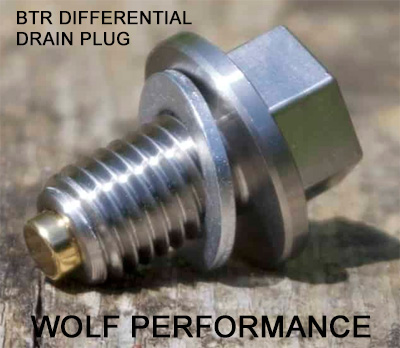
3. Remove the drain plug. (As a precaution, you can strain the lubricant to see if any debris is present.)
4. Replace the drain plug.
 5. If you are adding Friction Modifier, pour it into the
differential first. (from the MMC)
5. If you are adding Friction Modifier, pour it into the
differential first. (from the MMC)
6. Using a container or funnel/tube that allows access to the rear filler hole, now fill the differential until the lubricant runs out of the filler hole.
7. Replace the filler plug.
8. Clean the differential and check for leakage at both plugs after your first run.
BMW and BTR recommend that the fluid level be confirmed regularly but it need only be changed every 50,000 miles.
FLUIDS FOR NON-LSD BTRS
The correct oil for a non-LSD BTR was originally Castrol SAF-XO has been updated by BTR and now (2026) replaced by Castrol TRANSMAX Axle Long Life 75W-90. This fully synthetic, GL-5 gear oil is designed for conventional (non-limited slip) rear axles and is commonly used in BMW final drives. It is also very hard to find in North America.Greasing a BTR Axle
by Lorne Goldman
The BTR axles are closed end systems. There is no need to grease them for normal maintenance as is required for the Salisburys.
Filling a SALISBURY Axle
(LSD)
by Lorne Goldman (updated May 2020
)
| WATCHPOINT1: The
Morgan Salisburys are one-offs. Never used
on any vehicles save for Morgans. Parts from other Salisburys (which
went
the way of the dinosaur in 1996) are rarely interchangeable and
you would have to be a professional to recognise them.
The rumors of an old US Jeep relationship are untrue..though some
non-CW&P
items are similar to the one used in the old USA Studebaker. Salisbury
did not leave a supply of Morgan parts when it closed.
They had offered to produce a large supply of Morgan parts at 50%
before ending that line. However, Charles Morgan never replied, to
their letters and calls. So when Morgan woke
up to a sudden axle shortage, there was nothing similar to ship them.
That sert of circumstances seems to be the reason behind the
choice of the BTR axles, which are heavy items made for Australian
pickup trucks. As they were not modified for Morgans, it also explains
why the Morgan
rear ends suddenly ballooned in width in 1997 which
unfortunately vastly increases wind resistance and agility. I have one myself.
:( A wiser choice would have been to choose one of the fanatastic units made in the UK...Quaife for example. Charles Morgan's father Peter, had fit a Quife differential into the Salisbury 7HA making the legenday 12HA in 1995/1996, easily the best axle a Morgan ever had! It would have made the MMC less vulnerable to exchange rates (which have been unkind to Morgans since 1996) and the enormous shipping costs from Australia rather than a supplier from England. But there has not been an full automobile man at the MMC development since Bill Beck left in 2002.. :( |
| WATCHPOINT2: Aside from both being members of the Dana-Spicer group,
the Morgan Salisburys have no similarity to the later (current) BTR. They
should NOT be treated the same and have different recommended oils. This
is very important. There are no Morgan Salisbury crown wheel and pinions,
(the weakest part of that axle) to be had any longer (N.B. November 2011 Billy
Bellinger has solved that now ). If perfect care is
not taken, or the axle is abused, the consequences are disasterous. |
The original Morgan Motor Company recommended fluids for a LSD Salisbury (Plus 8s &
7HA and 12HA) is a 80/90 Hypoy oil for limited slip differential (LSD)
axles:
1. Royal Purple 80/90 LSD
2. Valvoline
(hard to find)
3. Mobil
75/90 or on Amazon UK
| 4/4s | Imperial Pints | 1.3 to 1.4 liters |
| Plus 4s | 2.5 Imperial Pints | 1.3 to 1.4 liters |
| Plus 8s | 2.5 Imperial Pints | 1.3 to 1.4 liters |
SALISBURY NON-LSDS
The recommended oil for a non-LSD Salisbury (4/4s and Plus 4s) is now Castrol 75/90 or its equivalent. Salisbury axle fluid should be ideally changed at 3000 miles intervals. One cannot exaggerate the need to be careful. Never mix old and new oils. Some of the newer dealers suggest what they believe to be modern synthetic equivalents. However, the Salisbury's are not noted for strength and parts are no longer made. A chipped Crown Wheel and/or Pinion will and has sidelined many Salisbury Morgans indefinitely, though they can be had with GREAT DIFFICULTY. As Salisbury's original recommendation has worked for 60 years, there is no logic in taking risks. A BTR can be fit, but MMC waiting times run into many months for a BTR and it is no longer known whether Classic Morgans will be supplied since these models have been abandonned. The cost of the axle and labor to remove the hubs, swap and weld the brackets and install a new BTR will cost £4000...unless the work is done by the owner and he is VERY lucky in their part sourcing.
To replace, take the car (if possible) on a short run to warm the lubricant a bit.
1. Place the car on a level surface.
2. Jack up the rear and remove the bottom plug of the differential and allow the lubricant to drain. (As a precaution, you can strain the fluid to see if any debris is present.)
3. Replace the bottom plug.
4. Remove the filler plug located at the rear right of the differential.
5. Remove the plug at the top of the differential.
6. Fill from the top until the lubricant leaks from the rear hole
7. Replace both plugs.
Greasing a SALISBURY Axle
by Lorne Goldman at the eMog Pub
The Morgan Salisbury axles have grease nipples at both ends near the hubs. They can be accessed by removing the rear compartment panel or from underneath. Often unseen (as it is traditionally covered in years of hardened grud and owner neglect) and placed opposite of the nipple on the axle shaft is a tiny excess grease hole. This is so often encrusted with paint or dirt that many newbies refuse to believe it exists. But manufacture was more precise and reliable then than it is now. They ALL have these holes. Scrub and clean the area with a solvent if you have not used it before. This will not make it visible but it will hopefully loosen/soften the crust enough to make it pop open and usable again. It is the only way to determine when you have greased enough (and the the two axle sections take a LOT of grease!) If this excess grease hole is too solidly blocked, you greasing can force out the seal on that side.
Assuming the hole is unblocked, the greasing is simple. Simply pump until you see a thin "worm" of grease coming out from this hole opposite the nipple. Repeat for the other end of the axle. Grease the axles and chnage the fluid at 3000 mile intervals.
Greasing a Morgan PROPSHAFT(4/4s,
Plus 4s, Plus 8s and Roadsters)
by Lorne Goldman at the eMog Pub
The Morgan propshaft has not changed much in 50 years...at
some point the splined end of the longer section changed from metal to
neoprene but little else of note was altered. From time to time, if it
is out for a period for another reason, it is could be wise to have it
tested for balance, as an unbalanced propshaft will 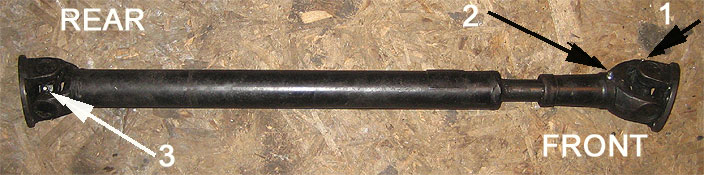 cause
vibration.
cause
vibration.
Sadly, though it requires very little care, it often doesn't get ANY! It needs to be greased and have come across many they haven't been seen a grease gun a decade and more after they left the Factory.
The propshaft has three grease points. One within the rear u-joint that it is bolted to the axle, a second at the front on the body of the propshaft that fills the propshaft itself and a third on the second u-joint at the front of the propshaft that is bolt to the output shaft of the gearbox.
The rear grease point is accessible from underneath or above the axle compartment. Raise the rear of the car and turn the rear wheels until you see the grease nipple and you have a good line on it for your greaser. The front two grease points are accessible from underneath the car or from an access panel at the right or left at the rear of the gearbox cover. The access panel will vary in placement or sometimes not exist at all!
Propshaft to Differential Flange Torque
by Lorne Goldman
Morgan does not give torque settings for this VERY important area...but both Salisbury and BTR do!
| SALISBURY - ALL | 35 ftlbs or 47 nm |
| BTR - ALL | 37 ftlbs or 50 nm |
| WATCHPOINT: Though Salisbury axles were very popular with many cars for many years, those used on Morgans were specifically made for Morgans. That being said Morgan Spares, the famous US dealer, has adapted the Salisbury from a Studebaker (IIRC) for Morgans. Excellent productfrom all accounts! Both can now can supply the once impossible-to-find final ratios as well as adding a wider choice for Morgan Plus 8 owners 4.1, 3.9, 3.7, 3.5, 3.3 and 3.08. |
Original Ratios
Plus 8s: (SALISBURY LSDs) (work in progress)
| NAME | WHEN |
FINAL RATIO |
COMMENTS |
| 7HA | 1968-1972 | 3:58 | |
| 7HA | 1972-1994 (?) | 3.31 | |
| 12HA | 1994-1995(?) | 3.31 | SALISBURY WITH A QUAIFE DIFFERENTIAL Inarguably the best stock axle ever used with a Morgan 4 wheeler |
| NAME | WHEN |
FINAL RATIO |
COMMENTS |
| BTR | 3:06 | ||
| BTR | 3.23 | ||
| BTR | 3.45 | ||
| BTR | 3.78 |
1. Clean area around U-Joint and Grease Nipple, removing any dirt or extra grease.
2. Apply grease gun end to Grease Nipple.
3. Begin pumping grease into U-Joint.
4. Watch for any liquid and debris to be purged from the caps of the joint.
5. Stop when new grease begins to be purged from the joint.
6. Wipe excess grease off U-Joint.
https://www.youtube.com/watch?v=8EzhKPM7e4o